Pre-Intermediate 1
Saturday Wednesday 16:30-18:00

Your Last Visit: 08:15:37 AM Refresh the Page
The Messages by the Teacher:
Class Activity Grades
95-100 ⇨ Excellent90-94 ⇨ Very Good
85-89 ⇨ Good
75-84 ⇨ Average
25-74 ⇨ Weak
78.0 آرین فخاری
70.0 حسین ختم مردانی
80.0 علی فرخی
81.0 حسن دارابی
70.0 سید امیرحسین ابراهیمی
93.0 امیر علی عمادی
99.0 صدرا درزی
93.0 سیدمحمدحسین طباطبایی
82.0 سینا توکل
94.0 آروین دارپرنیان
84.0 پارسا ایزدی
91.0 کیان امین فر
93.0 امیرحسین سعیدی
91.0 ارین مهری صومعه
84.0 پارسا نیک پیکر
90.0 یوسف گلزارنژاد
25.0 امیرعلی منسوجی روزبهانی
86.0 کوروش رحیمی
93.0 مهدیار قائد امینی هارونی
78.0 امیرعلی اردلان
80.0 امیرعلی باقری می آباد
80.0 علیرضا حنیفی
79.0 امیررضا ثریائی
89.0 صدرا بابایی
83.0 محمد حسین موسوی بزاز
Detailed Report of Class Activity Grades
4 ⇨ Good3 ⇨ OK
2 ⇨ Weak
1 ⇨ Not Ready
Student's ID Number: 9810050544
Name: آرین فخاری
Listening: 3
Mean = 3.0
Speaking: 4
Mean = 4.0
Reading: 1
Mean = 1.0
Writing: 1 4
Mean = 2.5
Pronunciation: 4
Mean = 4.0
Grammar: 4 4 3
Mean = 3.67
Vocabulary: 3
Mean = 3.0
Orthography: 3
Mean = 3.0
Assignment: 4
Mean = 4.0
Rating Scale = 3.1
Total Score = 78.0
Student's ID Number: 9910050105
Name: حسین ختم مردانی
Listening: 3
Mean = 3.0
Speaking: 2
Mean = 2.0
Reading: 3
Mean = 3.0
Writing: 3
Mean = 3.0
Pronunciation: 3
Mean = 3.0
Grammar: 2 1 4
Mean = 2.33
Vocabulary: 3
Mean = 3.0
Orthography: 3
Mean = 3.0
Assignment: 3
Mean = 3.0
Rating Scale = 2.79
Total Score = 70.0
Student's ID Number: 99853888
Name: علی فرخی
Listening: 3 4
Mean = 3.5
Speaking: 3
Mean = 3.0
Reading: 3
Mean = 3.0
Writing: 3
Mean = 3.0
Pronunciation: 4 3 3
Mean = 3.33
Grammar: 3 3 4
Mean = 3.33
Vocabulary: 3 3
Mean = 3.0
Orthography: 3
Mean = 3.0
Assignment: 3 4
Mean = 3.5
Rating Scale = 3.2
Total Score = 80.0
Student's ID Number: 9610150355
Name: حسن دارابی
Listening: 3
Mean = 3.0
Speaking: 3
Mean = 3.0
Reading: 3
Mean = 3.0
Writing: 3
Mean = 3.0
Pronunciation: 3 3
Mean = 3.0
Grammar: 4 4 4 4 4
Mean = 4.0
Vocabulary: 3 4 4
Mean = 3.67
Orthography: 3
Mean = 3.0
Assignment: 4 3
Mean = 3.5
Rating Scale = 3.23
Total Score = 81.0
Student's ID Number: 991523656
Name: سید امیرحسین ابراهیمی
Listening: 4
Mean = 4.0
Speaking: 1
Mean = 1.0
Reading: 1 3
Mean = 2.0
Writing: 3
Mean = 3.0
Pronunciation: 3 3 4
Mean = 3.33
Grammar: 3 3 4 4
Mean = 3.5
Vocabulary: 3
Mean = 3.0
Orthography: 3
Mean = 3.0
Assignment: 3
Mean = 3.0
Rating Scale = 2.8
Total Score = 70.0
Student's ID Number: 140215433752
Name: امیر علی عمادی
Listening: 3 4 4
Mean = 3.67
Speaking: 3 4 4 4 4
Mean = 3.8
Reading: 4 4 4
Mean = 4.0
Writing: 4 3 4 4
Mean = 3.75
Pronunciation: 4 4 3
Mean = 3.67
Grammar: 3 3 3 4 4
Mean = 3.4
Vocabulary: 3 4 4
Mean = 3.67
Orthography: 4 3 3 3
Mean = 3.25
Assignment: 4 4 4 4
Mean = 4.0
Rating Scale = 3.72
Total Score = 93.0
Student's ID Number: 9810190052
Name: صدرا درزی
Listening: 4
Mean = 4.0
Speaking: 4 4
Mean = 4.0
Reading: 4
Mean = 4.0
Writing: 4 4
Mean = 4.0
Pronunciation: 4 4 4 4 4
Mean = 4.0
Grammar: 4 4 4 4 4
Mean = 4.0
Vocabulary: 4 4 4 4
Mean = 4.0
Orthography: 3 3 4 4
Mean = 3.5
Assignment: 4 4
Mean = 4.0
Rating Scale = 3.96
Total Score = 99.0
Student's ID Number: 999835259
Name: سیدمحمدحسین طباطبایی
Listening: 3 4
Mean = 3.5
Speaking: 3 4 4 4
Mean = 3.75
Reading: 4 4 4
Mean = 4.0
Writing: 3 4 4
Mean = 3.67
Pronunciation: 4 4 3 4 4
Mean = 3.8
Grammar: 4 2 4 4 4
Mean = 3.6
Vocabulary: 4 3
Mean = 3.5
Orthography: 3 3 4
Mean = 3.33
Assignment: 4 4
Mean = 4.0
Rating Scale = 3.7
Total Score = 93.0
Student's ID Number: 9711040217
Name: سینا توکل
Listening: 3
Mean = 3.0
Speaking: 3 3 3
Mean = 3.0
Reading: 3
Mean = 3.0
Writing: 4 3
Mean = 3.5
Pronunciation: 3 2 4 4
Mean = 3.25
Grammar: 3 3 3 3 4
Mean = 3.2
Vocabulary: 3 4
Mean = 3.5
Orthography: 4
Mean = 4.0
Assignment: 3 3 4 4
Mean = 3.5
Rating Scale = 3.27
Total Score = 82.0
Student's ID Number: 9811210349
Name: آروین دارپرنیان
Listening: 4
Mean = 4.0
Speaking: 3
Mean = 3.0
Reading: 4
Mean = 4.0
Writing: 3
Mean = 3.0
Pronunciation: 4 3 4
Mean = 3.67
Grammar: 4 4 4 4 4
Mean = 4.0
Vocabulary: 4 4
Mean = 4.0
Orthography: 4
Mean = 4.0
Assignment: 4 4
Mean = 4.0
Rating Scale = 3.75
Total Score = 94.0
Student's ID Number: 140024672281
Name: پارسا ایزدی
Listening: 3
Mean = 3.0
Speaking: 4
Mean = 4.0
Reading: 3
Mean = 3.0
Writing: 3
Mean = 3.0
Pronunciation: 3
Mean = 3.0
Grammar: 3 3 4 4
Mean = 3.5
Vocabulary: 3
Mean = 3.0
Orthography: 4
Mean = 4.0
Assignment: 4 3 4
Mean = 3.67
Rating Scale = 3.34
Total Score = 84.0
Student's ID Number: 9810020927
Name: کیان امین فر
Listening: 3 4
Mean = 3.5
Speaking: 4 3
Mean = 3.5
Reading: 4
Mean = 4.0
Writing: 3 3
Mean = 3.0
Pronunciation: 4 4
Mean = 4.0
Grammar: 3 4
Mean = 3.5
Vocabulary: 3
Mean = 3.0
Orthography: 4 4
Mean = 4.0
Assignment: 4
Mean = 4.0
Rating Scale = 3.62
Total Score = 91.0
Student's ID Number: 9813040039
Name: امیرحسین سعیدی
Listening: 4
Mean = 4.0
Speaking: 3 4 4 4
Mean = 3.75
Reading: 4 4
Mean = 4.0
Writing: 3 4 3
Mean = 3.33
Pronunciation: 4 3 4 4
Mean = 3.75
Grammar: 3 3 3 4 2
Mean = 3.0
Vocabulary: 4 3 3
Mean = 3.33
Orthography: 4 4 4
Mean = 4.0
Assignment: 4 4
Mean = 4.0
Rating Scale = 3.72
Total Score = 93.0
Student's ID Number: 9930631208
Name: ارین مهری صومعه
Listening: 3 4
Mean = 3.5
Speaking: 3
Mean = 3.0
Reading: 4
Mean = 4.0
Writing: 4
Mean = 4.0
Pronunciation: 3 4
Mean = 3.5
Grammar: 4 3 3 4 4
Mean = 3.6
Vocabulary: 3 4 4 4
Mean = 3.75
Orthography: 3 4
Mean = 3.5
Assignment: 4 4
Mean = 4.0
Rating Scale = 3.63
Total Score = 91.0
Student's ID Number: 9713090092
Name: پارسا نیک پیکر
Listening: 3
Mean = 3.0
Speaking: 3 3
Mean = 3.0
Reading: 3
Mean = 3.0
Writing: 3 4
Mean = 3.5
Pronunciation: 3 4 4
Mean = 3.67
Grammar: 4 3 3 4 3
Mean = 3.4
Vocabulary: 3 4 4
Mean = 3.67
Orthography: 4
Mean = 4.0
Assignment: 4 3 4
Mean = 3.67
Rating Scale = 3.37
Total Score = 84.0
Student's ID Number: 1401408251815
Name: یوسف گلزارنژاد
Listening: 4 3
Mean = 3.5
Speaking: 3 4
Mean = 3.5
Reading: 3
Mean = 3.0
Writing: 4
Mean = 4.0
Pronunciation: 3 4
Mean = 3.5
Grammar: 4 3 3
Mean = 3.33
Vocabulary: 4
Mean = 4.0
Orthography: 4
Mean = 4.0
Assignment: 4
Mean = 4.0
Rating Scale = 3.6
Total Score = 90.0
Student's ID Number: 9825050004
Name: امیرعلی منسوجی روزبهانی
Listening: 1
Mean = 1.0
Speaking: 1
Mean = 1.0
Reading: 1
Mean = 1.0
Writing: 1
Mean = 1.0
Pronunciation: 1
Mean = 1.0
Grammar: 1 1
Mean = 1.0
Vocabulary: 1
Mean = 1.0
Orthography: 1
Mean = 1.0
Assignment: 1
Mean = 1.0
Rating Scale = 1.0
Total Score = 25.0
Student's ID Number: 1402409540101
Name: کوروش رحیمی
Listening: 3 4
Mean = 3.5
Speaking: 3 3 3 3
Mean = 3.0
Reading: 4 4 4 3 4
Mean = 3.8
Writing: 3 3 4 3 4
Mean = 3.4
Pronunciation: 3 3 3 4
Mean = 3.25
Grammar: 3 2 4 3 3
Mean = 3.0
Vocabulary: 3 3 4 4
Mean = 3.5
Orthography: 3 3 4 4
Mean = 3.5
Assignment: 4 4 4
Mean = 4.0
Rating Scale = 3.45
Total Score = 86.0
Student's ID Number: 1402412428611
Name: مهدیار قائد امینی هارونی
Listening: 3 4
Mean = 3.5
Speaking: 4 4
Mean = 4.0
Reading: 3 4
Mean = 3.5
Writing: 3 4
Mean = 3.5
Pronunciation: 3 4 4
Mean = 3.67
Grammar: 4 3 4 4 4
Mean = 3.8
Vocabulary: 3 4
Mean = 3.5
Orthography: 4
Mean = 4.0
Assignment: 4 4
Mean = 4.0
Rating Scale = 3.71
Total Score = 93.0
Student's ID Number: 9814190019
Name: امیرعلی اردلان
Listening: 3
Mean = 3.0
Speaking: 3
Mean = 3.0
Reading: 3 3
Mean = 3.0
Writing: 3
Mean = 3.0
Pronunciation: 3 3
Mean = 3.0
Grammar: 4 3 4
Mean = 3.67
Vocabulary: 3
Mean = 3.0
Orthography: 3
Mean = 3.0
Assignment: 3 4 3
Mean = 3.33
Rating Scale = 3.1
Total Score = 78.0
Student's ID Number: 9614180038
Name: امیرعلی باقری می آباد
Listening: 3
Mean = 3.0
Speaking: 3 3
Mean = 3.0
Reading: 3
Mean = 3.0
Writing: 4 3
Mean = 3.5
Pronunciation: 3 4 3 3 4
Mean = 3.4
Grammar: 3 3 3 4 4
Mean = 3.4
Vocabulary: 3
Mean = 3.0
Orthography: 3 4
Mean = 3.5
Assignment: 3 4
Mean = 3.5
Rating Scale = 3.21
Total Score = 80.0
Student's ID Number: 9714240018
Name: علیرضا حنیفی
Listening: 3
Mean = 3.0
Speaking: 3 4
Mean = 3.5
Reading: 3
Mean = 3.0
Writing: 4 3
Mean = 3.5
Pronunciation: 4 3 2 3
Mean = 3.0
Grammar: 2 2 3 4 3
Mean = 2.8
Vocabulary: 3
Mean = 3.0
Orthography: 3 4
Mean = 3.5
Assignment: 3 4
Mean = 3.5
Rating Scale = 3.18
Total Score = 80.0
Student's ID Number: 9614180130
Name: امیررضا ثریائی
Listening: 3
Mean = 3.0
Speaking: 3
Mean = 3.0
Reading: 2 3
Mean = 2.5
Writing: 3
Mean = 3.0
Pronunciation: 4 4
Mean = 4.0
Grammar: 3 3 4
Mean = 3.33
Vocabulary: 4 3
Mean = 3.5
Orthography: 3
Mean = 3.0
Assignment: 4 3
Mean = 3.5
Rating Scale = 3.18
Total Score = 79.0
Student's ID Number: 1401534205325
Name: صدرا بابایی
Listening: 3 4 4 3
Mean = 3.5
Speaking: 3 4 3 4 3
Mean = 3.4
Reading: 4 3 4 4 4
Mean = 3.8
Writing: 3 3 3 3 4
Mean = 3.2
Pronunciation: 3 4 4 4 4
Mean = 3.8
Grammar: 4 2 4 4 3
Mean = 3.4
Vocabulary: 4 3 3 3 3
Mean = 3.2
Orthography: 3 3 3 4 4
Mean = 3.4
Assignment: 4 4 4 4 4
Mean = 4.0
Rating Scale = 3.54
Total Score = 89.0
Student's ID Number: 9963136367
Name: محمد حسین موسوی بزاز
Listening: 4 3
Mean = 3.5
Speaking: 3
Mean = 3.0
Reading: 3
Mean = 3.0
Writing: 3
Mean = 3.0
Pronunciation: 3 3 3 3 3
Mean = 3.0
Grammar: 4 3 4 3
Mean = 3.5
Vocabulary: 4 3 3
Mean = 3.33
Orthography: 4
Mean = 4.0
Assignment: 4 3 4
Mean = 3.67
Rating Scale = 3.31
Total Score = 83.0
Session 20
Unit 8: Listening
AUDIO SCRIPT
One:
- I feel terrible today. I ate too much last night, my stomach doesn’t feel well at all.
- You should take something for it.
Two:
- This pain in my head is terrible.
- Let me get you some aspirin.
- Thanks. That’s just what I need.
Three:
- I’m not going to school today. I’ve gotta see the dentist. My tooth is really bothering me.
- Oh, that’s too bad.
Four: - I think I’ll stay in bed today. I think I hurt myself carrying those bags in the weekend. My back is killing me.
- Can I give you a massage? Maybe that will help.
- Oh, yeah. Thanks. I’ll try anything.
Five:
- How do you feel?
- Sorry, I can’t talk.
- Let me get you some hot lemon tea. That should help.
- Thanks.
Six: - I need to go to the drugstore. I have a bad cold. (sneeze)…. My head is all stuffed up.
- Oh, that’s too bad. I hope you feel better soon.
KEY TO THE LISTENING EXERCISE
1. a
2. b
3. a
4. a
5. b
6. a
Follow-Up
1. e
2. c
3. b
4. f
5. a
6. d
Workbook: Unit 8
Exercise A1. pity 2. task 3. bother 4. advise 5. avoid 6. intensive
Exercise B
1. underpopulated 2. disobeys 3. unnecessary 4. unsuitable 5. illogical 6. misplaced
Exercise C
1. bought 2. read 3. been practicing 4. appeared 5. caught 6. been waiting
Exercise D
1. Example
2. Jack has been painting the house for four days.
3. We have been waiting for the bus since 8:30.
4. It has been raining since Saturday.
5. Tom has been building boats for 20 years.
6. Prices have been going up since last year.
Exercise E
1. have you had
2. No change
3. got married
4. No change
5. it stopped
6. No change
Exercise F
1. Example
2. A: Are they still painting?
B: Yes, they are.
A: How long have they been painting?
B: They have been painting since 9 o'clock / for two hours.
3. A: Are they still waiting?
B: Yes, they are.
A: How long have they been waiting?
B: They have been waiting since 10:30 / for half an hour.
4. A: Is he still studying?
B: Yes, he is.
A: How long has he been studying?
B: He has been studying since 5 o'clock / for seven hours.
5. A: Is she still watching TV?
B: Yes, she is.
A: How long has she been watching TV?
B: She has been watching TV since 6 o'clock / for three hours.
6. A: Is she still playing the piano?
B: Yes, she is.
A: How long has she been playing the piano?
B: She has been playing the piano since 3:30 / for one and a half hours.
✍Homework:
📖Workbook (Unit 8)Session 19
8.2
They’ve slept for an hour.
They’ve been sleeping for an hour.
She’s helped her mother for an hour.
She’s been helping her mother for an hour.
They’ve played in the yard for an hour.
They’ve been playing in the yard for an hour.
He’s written letters for an hour.
He’s been writing letters for an hour.
It’s bothered for an hour.
It’s been bothering me for an hour.
8.4
Has he been working in a factory for a long time?
Has she been practicing the piano for a long time?
Have they been teaching Russian for a long time?
Have you been studying English for a long time?
Has Betty talking on the phone for a long time?
8.5
Yes, I have. / No, I haven’t.
Yes, he has. / No, he hasn’t.
Yes, I have. / No, I haven’t.
Yes, she has. / No, she hasn’t.
work out = exercise
Yes, they have. / No, they haven’t.
8.6
How long has Mary been learning French?
Whom has John been waiting for?
What have they been playing since they were ten?
How have you been studying for a week?
Who has been watching television all day?
8.7
… because they have no paper or pencil.
… because we have no typewriter.
… because she has no telephone.
… because we have no TV set.
… because he has no tape recorder.
8.8
He may check my blood pressure.
It may make you cheerful.
cheerful = very happy
I may work overseas.
They may buy some equipment.
She may take his pulse.
8.11
…, was it?
…, don’t you?
…, isn’t he?
…, has he?
…, didn’t they?
8.12
Because I have sprained my knee.
Because she hasn’t slept a wink for days.
Because they haven’t studied for the exam.
Because he has gotten a raise.
Because she has lost her wedding ring.
✍Homework:
❓Five Questions on the Dialog of Unit Eight🗣️Summary of the Dialog in Unit Eight
Session 18
Unit 7: WORKBOOK EXERCISES
Exercise A1. views
2. interfere
3. professional
4. confidence
5. give up
6. graduated
Exercise B
1. monorail
2. prehistoric
3. prejudge
4. postgraduate
5. bimonthly
6. preschool
Exercise C
1. Example
2. Have you met your new neighbors yet?
3. Have you written the letter yet?
4. Has he sold his car yet?
5. Have you worn your new dress yet?
6. Have you seen the new movie yet?
Exercise D
1. have been
2. came
3. have opened
4. have just asked
5. hasn't decided
6. bought
Exercise E
1. Did you see
2. No change
3. I've already washed and dried them.
4. Have you ever been on a big ship?
5. No change
6. have Sarah and Roger been married
Exercise F
1. A: Has she brushed her teeth yet?
B: Yes, she has already brushed her teeth.
2. A: Has she read the morning paper yet?
B: No, she hasn't read the morning paper yet.
3. A: Has she telephoned her mother yet?
B: Yes, she has just telephoned her mother.
4. A: Has she made some toast yet?
B: No, she hasn't made any toast yet.
5. A: Has she drunk a cup of tea yet?
B: No, she hasn't drunk a cup of tea yet.
6. A: Has she turned on the radio yet?
B: Yes, she has just turned on the radio.
✍Homework:
❓Seven Questions on the Reading of Unit 7🗣️Summary of the Reading in Unit 7
📖Workbook (Unit 7)
Session 17
7.3
No, it hasn’t. But it may land later.
No, it hasn’t. But it may go out later.
No, they haven’t. But they may eat it later.
No, I haven’t. But I may see him later.
No, she hasn’t. But she may tell her later.
7.5
No, she isn’t. She’s just mailed it.
No, I’m not. I’ve just taken it.
No, he isn’t. He’s just brought it.
No, he isn’t. He’s just left one.
No, I’m not. I’ve just instructed them.
7.6
I’ve already closed it.
I’ve already read it.
I’ve already explained it.
I’ve already repeated it.
I’ve already painted it.
7.7
No, I haven’t taken one yet.
No, he hasn’t left it yet.
No, it hasn’t finished yet.
No, they haven’t taken it yet.
No, they haven’t called at it yet.
call at = visit
7.8
Yes, I’ve already spoken to him.
Yes, he’s already talked to him.
Yes, I’ve already found it.
Yes, she’s already eaten it.
Yes, she’s already taken it.
7.10
He’s recently smashed up his car.
She’s recently gotten a raise.
I’ve recently found a part-time job.
He’s recently given up smoking.
They’ve recently bought a house.
7.12
Which car have they chosen?
How many application forms has he filled out?
Whose ring has Jane lost?
How many employment agencies have you been to?
How much time have they had?
Unit 7: Reading
I will graduate from college next year. I am majoring in civil engineering. So I have decided to find myself a part-time job to get some experience in my field.
I have been looking for quite a while recently, but I haven't made much progress toward finding a job I like. I have listed my name at a few employment agencies. They have given me information about several positions; but most of them are full-time jobs, so I am not interested in any of them.
Last month, I filled out an application form for a company. I got a phone call from them a week later. They asked me to go there and have an interview with the boss. On the day of the appointment, I was really anxious. Have you ever had job interviews? You get so anxious that you might lose your confidence. That day, I woke up very early, took a shower and shaved. I put on my best suit and tried to look really professional.
I arrived at the office on time but had to wait for a while. When I finally had my interview with the boss, I realized the working hours the company offered would interfere with my class hours at the university. So I am back to looking for a job again!
Today, however, I had another phone call from another company. The secretary has set an appointment for me with the president on Wednesday. This time I won't be so anxious because I am more experienced in job interviews. The job they offer seems very good, and I am confident I can take it. I've had enough of looking for a job, and it's about time to find one.
Sample Summary:
John is a civil engineering student who will graduate next year and is looking for a part-time job to gain experience. Despite his efforts, he hasn’t found a suitable job yet, as most opportunities are full-time. He had an interview with one company, but the job’s hours conflicted with his classes. Now, he has another interview scheduled and feels more confident and experienced. He is hopeful this job will be a good fit and is eager to stop job hunting.
✍Homework:
❓Five Questions on the Dialog of Unit Seven🗣️Summary of the Dialog in Unit Seven
Session 16
Unit 7: Dialog
Mike arrives at the office and finds the atmosphere unusual.
Mike: Why’s everything so unusual today?
Terry: Haven’t you heard the news? Tom’s in hot water.
Mike: Why? What’s he done?
Terry: He took the company car without permission and smashed it up.
Mike: How awful! Is he OK?
Terry: Yes, but I wouldn’t like to be in his shoes when the boss finds out.
Mike: Oh, he’ll make up a good story and get off the hook.
Terry: Yeah, he’s always like that.
Sample Summary:
Mike arrives at work and notices something is off. Terry tells him that Tom is in trouble because he took the company car without permission and crashed it. Tom is okay, but they both think he will try to make up a story to avoid getting into serious trouble.
Sample Summary:
Mike gets to work and senses something is different. Terry explains that Tom is in trouble for taking the company car without permission and crashing it. Although Tom is fine, they both think he will try to come up with an excuse to avoid serious consequences.
Unit 7: Listening
Audio Script
One
Woman 1: So, what kind of job are you looking for?
Man 1: Well, I haven't made up my mind. I love working with people, and I love traveling. I don't want a job where I'm stuck in an office all day. I want to get out and see the world.
Woman 1: Are you interested in working in business? That's where you can sometimes make good money.
Man 1: I'm not really interested in making a lot of money at this point in my life. I’ll worry about that later.
Two
Man 2: What kind of career are you planning for yourself?
Woman 2: I don't know. I think I'd like to have a job where I can help people. Everybody else in my family is in law or business – you know, boring stuff like that. That's just not for me. I know I'd like to work overseas, though. Maybe in a children's hospital in a developing country. But that's a long way away. I have to get into medical school first, and that's not going to be easy!
Three
Man 3: What kind of job do I have in mind? Well, I don't want a regular nine-to-five job. Eventually, I'd like to get into acting – maybe even break into movies. But I guess that won't happen for a while.
Woman 1: So, what are you doing in the meantime?
Man 1: Well, I work out at the gym nearly every day. I need to be really fit. And I'm taking acting lessons as well so that I feel comfortable in front of the crowd. I just had some pictures taken to show agents in the city. Would you like to see them?
Woman 1: Sure.
KEY TO THE LISTENING EXERCISE
1. flight attendant
2. doctor
3. model
Summary
Three people talk about their job dreams and what they are doing now. The first person wants a job that lets him travel and meet people. He doesn't want to be stuck in an office, and isn’t worried about money right now. The second person wants to help people, maybe in a children’s hospital overseas, but needs to get into medical school first, which is hard. The third person wants to be an actor and is working out, taking acting lessons, and getting photos taken to show the agents.
New Words & Expressions
- make up my mind: decide
- stuck in an office: trapped or confined in an office
- get out and see the world: travel and explore different places
- career: a long-term job or profession
- overseas: in another country, usually across the ocean
- developing country: a country that is not economically advanced
- medical school: a faculty at university where people study to become doctors
- regular nine-to-five job: a typical job with standard working hours from 9 AM to 5 PM
- break into movies: Start a career in the film industry
- in the meantime: during the time before something happens
- work out: exercise
- fit: in good physical shape
- acting lessons: classes to learn how to act
- comfortable in front of the crowd: feel at ease when performing in front of people
- agents: people who help actors find jobs in movies or shows
Make-Up Class:
Friday (Sharivar 16)
8:00 a.m. - 9:30 a.m.
Note:
There is no class on Wednesday (Sharivar 14) because it is a public holiday.
☕ No Homework for Next Session
Session 15
Workbook: Unit 6Exercise A
1. scratches
2. loose
3. chip
4. replacing
5. strap
6. transmitted
Exercise B
1. transformed
2. co-author
3. co-starred
4. transplant
5. transport
6. co-pilot
transform = change
Exercise C
1. have had
2. bought
3. did you go
4. went
5. stayed
6. have had
pen pal = someone who you exchange letters or messages with as a hobby, but usually have not met
pen pal (American) = pen friend (British)
Exercise D
1. Example
2. He has been here since Sunday.
3. She has been in her office since 7 o'clock.
4. I have had a Japanese camera since 2000.
5. We have known Sue for two years / since two years ago.
6. He has been in the hospital for five days / since five days ago.
Exercise E
1. No, never.
2. No change
3. I saw her
4. he has taught / he has been teaching
5. No change
6. for ten years
Note:
Don't use the present perfect tense with definite time for example "two days ago", "last week", ...
Use the simple past with definite time.
Exercise F
Answers may vary.
1. Example
2. A: Have you ever eaten Chinese food?
B: Yes, I have.
A: How many times?
B: Just once.
A: When was it?
B: Last year.
3. A: Have you ever been to the hospital?
B: Yes, I have.
A: How many times?
B: Three times.
A: When was the last time you were there?
B: Two months ago.
4. A: Have you ever lived in a foreign country?
B: No, I haven't.
5. A: Have you ever stayed in an expensive hotel?
B: Yes, I have.
A: How many times?
B: Several times.
A: When was the last time you stayed in one?
B: Last summer.
6. A: Have you ever cooked a meal for your family?
B: Yes, I have.
A: How many times?
B: Many times.
A: When was the last time you cooked one?
B: Last night.
Unit 6: Pre-Listening
1. The vase is cracked and chipped.
2. The CD is scratched.
3. The sunglasses are broken and scratched.
4. The jeans are torn.
5. There is a stain on the shirt. = The shirt is stained.
Unit 6: Listening
Audio Script
One:
- Can I exchange this belt, please?
- What’s the problem?
- I asked for a size 34, but this is a size 24.
- Of course. Let’s look for a size 34 for you.
Two:
- I’d like to exchange these shoes, please.
- Oh, Are they the wrong size?
- No, the size is OK. But the heel is coming off of this one, see.
Three:
- Excuse me. I bought this briefcase here the other day. Look, here’s my receipt.
- Yes.
- The problem is I can’t get the lock to work.
- Strange. Let me see. Oh, yes, I see the problem. I can fix that for you.
Four:
- I’d like to exchange these jeans, please.
- What’s wrong? Are they the wrong size?
- No, the size is OK. But there’s a little hole in the back. Right here.
- Oh, really. Well, no problem. Let me exchange them for you.
Five:
- Excuse me. I’d like to exchange this watch. I just bought it but look at this.
- What seems to be the problem?
- Well, the strap is broken, see.
- Yes, I see. Well, just find another one, then.
Six:
- Excuse me. I’d like to return this shirt.
- Is there a problem?
- Yes, you see, the sleeves. Believe it or not, this used to be a long-sleeve shirt.
- Really?
- Yeah. I washed it and look at the sleeves now.
- I see what you mean. Well, would you like something else?
Seven:
- I’m afraid there’s something wrong with the camera I bought.
- Really? What’s the problem?
- The flash isn’t working. Let me show you. See what I mean.
- Oh, yes. I’ll get you a new flash.
Eight:
- What seems to be the problem with the blouse, Miss?
- Well, look what happened the first time I washed it. The color changed completely.
KEY TO THE LISTENING EXERCISE
1. a
2. a
3. b
4. b
5. a
6. b
7. a
8. b
New Words
Exchange: To return an item and get another one in its place.
Heel: The back part of a shoe that supports the foot.
Briefcase: A flat, rectangular bag used for carrying documents.
Receipt: A document that shows proof of purchase.
Lock: A device used to secure something, such as a briefcase.
Hole: An opening or gap in something.
Strap: A narrow piece of material used to fasten or carry something, like a watch.
Sleeves: The parts of a shirt that cover the arms.
Flash: A device on a camera that produces a burst of light.
Blouse: A woman’s shirt.
✍Homework:
❓Seven Questions on the Reading of Unit 6🗣️Summary of the Reading in Unit 6
📖Workbook (Unit 6)
Session 14
6.3
Have you damaged it?
Have you replaced them?
Have you burned it?
Have you washed them?
Have you mailed it?
6.4
Yes, I have studied it for a long time.
Yes, he has worked there for a long time.
Yes, he has lived there for a long time.
Yes, they have lived there for a long time.
Yes, he has studied it for a long time.
6.6
I’ve worked here since 1980.
She’s waited for me since noon.
They’ve worked there since November.
She’s lived there since May.
He’s been a lawyer since lawyer.
6.7
He’s been in London for many years.
He’s lived in New York since 1980.
He’s taught French for three years.
I’ve waited for them for a short time.
I’ve studied English since last year.
6.9
Yes, they have. / No, they haven’t.
Yes, she has. / No, she hasn't.
Yes, I have. / No, I haven’t.
Yes, he has. / No, he hasn’t.
Yes, I have. / No, I haven't.
6.10
No, they haven’t ever given directions.
No, they have never given directions.
No, he hasn’t ever saved his money.
No, he has never saved his money.
No, they haven’t ever gone to concerts.
No, they have never gone to concerts.
No, she hasn’t ever helped me.
No, she has never helped me.
No, he hasn’t ever come to class late.
No, he has never come to class late.
6.12
Yes, they have usually shrunk.
Yes, he has seen it twice.
Yes, I have sometimes scratched them.
Yes, it has damaged it many times.
Yes, she has often had a delivery.
Unit 6: Reading
People used to know more or less how their children would live. Now things are changing so quickly that we don't even know what our own lives will be like in a few years. What follows is not science fiction. It's how experts see the future.
You're daydreaming behind the wheel of your car, but that's OK. You have it on automatic pilot, and with its high-tech computers and cameras, your car "knows" how to get you home safely.
You're hungry, so you head for the kitchen as soon as you get home. You ordered groceries by computer an hour ago, and you know that by now they've arrived. Your kitchen has a two-way refrigerator, which opens to the outside to accept deliveries. You've already paid for the food by having the money subtracted from your bank account. Nobody uses cash anymore.
What's for lunch? In the old days, you used to stop off to buy a hamburger or pizza. Now you use your diagnostic machine to find out which foods your body needs. You find out you need more vegetables and less fat. Your food-preparation machine makes you a salad.
After lunch, you go down the hall to your home office. Here you have everything you need for doing your work. Thanks to your information screen and your new computer, you almost never go into the office anymore.
The information screen shows an urgent message from a co-worker in Brazil. You set the screen to translate Portuguese into English. As you wait, you think about later, when you'll have a movie transmitted. What movie should you order tonight?
✍Homework:
❓Five Questions on the Dialog of Unit 6🗣️Summary of the Dialog in Unit 6
Session 13
Unit 5: WORKBOOK EXERCISES
Exercise A1. adorable 2. realize 3. complicated 4. gain 5. courageous 6. silent
Exercise B
1. overeats
2. overcrowded
3. undercut
4. overtime
5. undersea
6. overuse
Exercise C
1. d
2. e
3. g
4. c
5. b
6. a
Exercise D
1. were there?
2. aren't they?
3. doesn't he?
4. doesn't she?
5. will you?
6. wouldn't we?
Exercise E
1. shouldn't he?
2. No change
3. No change
4. is it?
5. aren't there?
6. were you?
Exercise F
1. Example
2. A: He looks tired, doesn't he?
B: Yes, he does. He should take a rest.
3. A: She lives in Paris, doesn't she?
B: Yes, Paris is very beautiful. Let's visit her this summer.
4. A: It was cold last night, wasn't it?
B: Yes, it was really cold. I couldn't sleep at all.
5. A: There is nothing in the fridge, is there?
B: No, it's empty. Let's go shopping this afternoon.
6. A: She can play the piano, can't she?
B: Yes, she plays the piano very well. Let's ask her to play it now.
Unit 6: Dialog
Mrs. Kidman’s vacuum cleaner does not work.
Repairman: Is there anything I can help you with?
Mrs. Kidman: Yes, please. My vacuum cleaner is broken.
Repairman: OK. What's wrong with it?
Mrs. Kidman: The problem is it won't start.
Repairman: Let me take a look.... Oh, here, you need a new switch.
Mrs. Kidman: Looks like there's no need to leave it here.
Repairman: No, you can wait here. And how long have you had it?
Mrs. Kidman: I've had it since February, I guess.
Repairman: So, the repair won't cost you anything. It's still under warranty.
✍Homework:
❓Seven Questions on the Reading of Unit 5
🗣️Summary of the Reading in Unit 5
📖Workbook (Unit 5)
Session 12
5.3…, didn’t he?
…, wasn’t she?
…, didn’t they?
…, shouldn’t I?
…, isn’t it?
5.5
You don’t have any candles, do you?
You aren’t married, are you?
You weren’t chatting, were you?
You didn’t get divorced, did you?
You couldn’t lend me some money, could you?
5.6
…, can she?
…, does he?
…, didn’t they?
…, shouldn’t I?
…, was it?
5.9
…, won’t he?
…, can’t you?
…, isn’t he?
…, didn’t she?
…, didn’t he?
5.12
…, won’t she?
…, won’t he?
…, won’t you?
…, won’t it?
…, will she?
Unit 5: Reading
Last week, Jane went to see a fortune-teller. She doesn't really believe in fortune-telling, but she thought it might be fun.
When she arrived at the fortune-teller's, she found the room very dark. She looked around but didn't see anyone. Suddenly a voice said, "Will you have a seat, please?" Jane obeyed the old lady and sat down.
"I'll tell you your fortune," said the old lady. "I can see your future in my crystal ball. Ah, you'll be very successful in life. You'll have a long, long life."
"Who will I marry?" asked Jane.
"You'll marry a rich and handsome man," the old lady replied.
All of a sudden, the fortune-teller was silent. The smoke from the candles became heavier. Then the old lady continued, "I see that today you will receive a very important note. It has something to do with money. That's all I can tell you for now."
Jane was very pleased and she thanked the lady. She paid for the fortune-telling and then she left. When Jane returned to her car, she noticed a note on her windshield!
Jane smiled and thought, "This may be that important note." She read the note and her smile disappeared. It was a parking ticket for twenty-five dollars.
"What bad luck!" admitted Jane. The fortune-teller was right. The note did have something to do with money!
Sample Summary:
Jane visited a fortune-teller for fun. The fortune-teller predicted Jane would be successful, live long, and marry a rich, handsome man. She also mentioned Jane would receive an important note related to money that day. After leaving, Jane found a parking ticket on her car, and understood the fortune-teller’s prediction was true, but not in the way she expected.
✍Homework:
❓Five Questions on the Dialog of Unit 5🗣️Summary of the Dialog in Unit 5
Session 11
🗣️The Dialog of Unit 5
Ellen sees her old school friend at a reunion. They are having a chat.
Ellen: Alice? Remember me? I'm your friend Ellen, from school.
Alice: Sure, I remember you. It's been a long time.
Ellen: Yeah, really. What's new?
Alice: Well, I'm married now. I got married six years ago.
Ellen: Still living in Dallas, aren't you?
Alice: That's right. The kids like it here.
Ellen: I can't believe you have children.
Alice: Well, time flies, doesn't it?
Ellen: Yeah, it seems like only yesterday that we were kids.
Sample Summary:
Ellen meets her old school friend Alice at a reunion. They talk about how much time has passed. Alice shares that she got married six years ago and still lives in Dallas with her children. Ellen is surprised that Alice has kids, and they both agree that time flies.
🎧The Listening of Unit 5
KEY TO THE LISTENING EXERCISE
1. Linda couldn't stand Scott at first, but a year later, she married him.
2. Her hair is much shorter now.
3. He is fatter now.
4. They have two children now.
Audio Script
Linda: What are you looking at, Scott?
Scott: Oh, just one of our photo albums.
Linda: Oh, look – it's our wedding picture!
Scott: Yeah. Just think, we'll be celebrating our fifth wedding anniversary this month.
Linda: Yeah, and I remember I couldn't stand you when we first met. But a year later, we fell in love and got married.
Scott: And here's a picture of our honeymoon. Wow! We sure look different now, don't we?
Linda: Yes! My hair is much shorter now. And you've gained a little weight. You were always too thin! Oh, and look, here's a picture of the day we brought Maggie home from the hospital.
Scott: She's adorable. And now we have two kids! Who would have guessed?
Linda: Yeah. We're just lucky that they look like me!
Summary:
Linda and Scott are looking at their photo album. They are talking about their wedding, honeymoon, and how much they have changed over the years. Heir hair is shorter now and Scott gained weight after their marriage, and he is fatter now. They also talk about their two kids and how lucky they feel.
☕No Homework for Next Session
Session 10
Unit 4: WORKBOOK EXERCISESExercise A
1. requires 2. available 3. various 4. procedure 5. remedy 6. minor
require = need
available = on hand
various = different
procedure = method
remedy = treatment, cure
minor = unimportant, not serious
Exercise B
1. misinformed 2. misheard 3. rebuilt 4. mistreat 5. mispronounce 6. renamed
mis = wrongly
re = again
Exercise C
1. Example
2. I think I should send him a card.
3. I think they shouldn't get married.
4. I think we shouldn't stay here.
5. I think he should go to the doctor.
6. I think we should go home now.
Exercise D
1. Example
2. You ought to see a dentist.
3. I may see you on Thursday evening.
4. We shouldn’t stay in the sun anymore.
5. Our team may win the game.
6. The passengers ought to arrive at the airport an hour before their flights.
Exercise E
1. No change
2. should go
3. ought to wash
4. shouldn't watch
5. No change
6. No change
Exercise F
1. Example
2. A: Betty has a bad toothache. What do you think she should do?
B: She should go to the dentist.
3. A: The tourists are lost. What do you think they should do?
B: They should look at a map.
4. A: There is a lot of snow. What do you think Sam should do?
B: He should wear his boots.
5. A: Pete has a lot of accidents. What do you think he should do?
B: He should drive more carefully.
6. A: Helen has a splitting headache. What do you think she should do?
B: She should take a stronger painkiller.
Unit 4: Pre-Listening Exercise
1. take vitamin C or cold medicine
2. gargle with warm water
3. take aspirin
4. go to a dentist
5. stay in bed
6. take an antacid
7. see an orthopedist
🎧Unit 4: Listening
AUDIO SCRIPT
One:
- What do you do for a bad cold, Ted?
Ted: - Oh, I’ve got this great cold remedy. It always works. I chop up a bunch of garlic and drink it with hot water.
- Oh, Yuk.
Two:
- What do you think is the best thing to take for a cold?
- I just take some cold medicine. That’s about all you can do.
Three:
- Do you have a good cold remedy?
- Oh, sure. Chicken soup. Have some and I guarantee you you’ll feel better.
- Great. But who’ll make the soup? I don’t know how to cook.
- Hey. Don’t look at me. You can get a can of soup at any supermarket.
Four:
-What do you take for cold, Helen?
Helen: Oh, orange juice. It’s supposed to be good for you because it contains a lot of vitamin C. So, I make a big pitcher of it and drink it all the time.
KEY TO THE LISTENING EXERCISE
1. Chop up a bunch of garlic and drink it with hot water.
2. Take some cold medicine.
3. Have some chicken soup.
4. Drink a lot of orange juice.
✍Homework:
❓Seven Questions on the Reading of Unit 4🗣️Summary of the Reading in Unit 4
📖Workbook (Unit 4)
Session 9
Unit 4: Grammar Exercises4.3
She should get more exercise.
They should go to bed early.
He should practice more.
He should study hard.
He should do his best.
4.5
Should I go to the doctor’s?
Should he ask his teacher?
Should she take an aspirin?
Should I give him first aid?
Should she study hard?
4.6
No, we shouldn’t.
Yes, they should.
No, they shouldn’t.
Yes, I should.
No, they shouldn’t.
4.7
I should study hard.
I should have $5000.
I should go to bed at 10 p.m.
I should go to the bank.
I should go on a diet.
4.8
I should say, “Fine, thanks.”
They should study hard.
I should say, “Hello”.
I should see a doctor.
I should lose weight.
4.10
She ought to practice more.
He ought to look for one.
She ought to be careful.
He ought to hang up his clothes.
He ought to go to the bank.
4.12
He ought to ask for advice.
I ought to learn it.
He ought to buy one.
They ought to get some rest.
She ought to see a doctor.
✍Homework:
📖Five Questions on the Dialog of Unit 4🗣️Summary of the Dialog in Unit 4
Session 8
Unit 3: Workbook
Exercise A1. favor
2. common
3. rate
4. Courage
5. feed
6. freedom
Exercise B
1. superpowers
2. substandard
3. subzero
4. superstars
5. supernatural
6. supermarket
Exercise C
1. would the children like
2. They'd like mineral water.
3. She'd like a lemonade with ice.
4. She'd like a cup of tea.
5. I'd like iced tea.
6. She'd like a chicken sandwich.
Exercise D
1. Example
2. Would you please give me the key to my room?
3. Would you please explain the meaning of the word deposit?
4. Would you please give me change for a dollar?
5. Would you please take a photo of me and my friends?
6. Would you please show me the brown shoes in the window?
Exercise D
1. Would you like
2. Would / Will you please
3. to lend
4. No change
5. I'd like
6. No change
Exercise F
1. Example
2. A: How would he like to go to work today?
B: He would like to go to work by taxi.
3. A: Where would he like to eat today?
B: He would like to eat in a restaurant.
4. A: What would he like to do after lunch today?
B: He would like to take a walk.
5. A: Who would he like to invite to his house at 10:00?
B: He would like to invite his friends to his house at 10:00.
6. A: What time would he like to go to bed tonight?
B: He would like to go to bed at 12:00.
Unit 4: Dialog
Carol has an exam today and she feels awfully anxious.
Carol: You know, Amy? I didn’t sleep a wink last night. I’m afraid I might fail.
Amy: Don’t be silly, Carol. Worrying won’t help.
Carol: That’s easy for you to say, but I do worry.
Amy: Well, in the first place, you should try to do your best.
Carol: But what if I do my best and still fail?
Amy: Failure is not the end. That’s how you ought to think about it.
Carol: I don’t see it that way and I’m worried to death.
Amy: You must learn from your mistakes, Carol. That’s how to become wise.
The New Words of the Dialog in Unit 4
failure ≠ success, victory
failure = not winning; defeat
exam = examination, test, quiz
awfully = terribly, very, too, so
anxious = stressed out, worried, nervous
I didn't sleep a wink. = I didn't sleep at all.
afraid = scared, fearful, nervous
might = may
fail ≠ pass
silly = stupid, foolish
worrying = having stress
I do worry. => Emphatic Sentence
I do worry. = I really worry. = Indeed, I worry.
worry (verb) = feel worried
worried (adjective) = stressed out, nervous, anxious
in the first place = at first, first of all
what if = what will happen
still = even so, despite that
ought to = should
I don’t see it that way. = I think about it differently.
to death = a lot
wise (adj.) = sensible, logical ≠ foolish
Sample Summary:
Carol is very anxious about her exam and fears failing. Amy reassures her that worrying won’t help and encourages her to do her best. Amy explains that failure isn’t the end and that learning from mistakes is important for becoming wise.
✍Homework:
Workbook (Unit 3)Seven Questions on the Reading of Unit 3
Summary of the Reading in Unit 3
Session 7
3.7No, I wouldn’t.
Yes, I would.
No, I wouldn’t.
Yes, I would.
Yes, I would.
3.8
Please pronounce this word for me.
Please cash this check for him.
Please make some tea for them.
Please say “hello” to him for us.
Please take the clothes to the laundry for her.
3.11
Will you please introduce him to them?
Will you please repeat it to him?
Will you please explain it to me?
Will you please give it to him?
Will you please describe it to us?
3.12
Won't you stay for lunch?
Won't you stay longer?
Won't you rest for a while?
Won't you take some more?
Won't you stop by tonight?
Unit 3: Reading
Unit 4: Vocabulary
✍Homework:
Five Questions on the Dialog of Unit 3Summary of the Dialog in Unit 3
Session 6
Unit 3: Dialog
Mr. Harris plans to stay a hotel during his visit to London.
Mr Harris: Could I have a room for one night?
Receptionist: A single room or a double room?
Mr. Harris: Single, please. And what are your rates?
Receptionist: Forty dollars for the room and breakfast. Would you like an evening meal?
Mr. Harris: No, thanks. Just Breakfast. Can I pay by credit card?
Receptionist: Yes, of course. Will you sign the register, please?
Mr. Harris: Sure. And is there anybody to carry my baggage?
Receptionist: Certainly. Here’s your key, and I hope you’ll enjoy your stay.
Sample Summary
Mr. Harris is visiting London and wants to stay at a hotel. He asks the receptionist for a room for one night. The receptionist offers a single or double room. Mr. Harris chooses a single room and asks about the rates. The receptionist informs him that it's forty dollars for the room, including breakfast. Mr. Harris doesn't want to have an evening meal and asks if he can pay by credit card. The receptionist says that it is possible for him to pay by credit card and asks him to sign the register. Finally, Mr. Harris wants to know if there's someone to carry his baggage, and the receptionist assures him there is. Mr. Harris receives his key and the receptionist hopes he will have an enjoyable stay at the hotel.
🔊Unit 3: Listening
Audio Script
One:
R: Would you like a single or a double room?
G: Single is fine. Thanks.
R: Smoking or non-smoking?
G: Smoking, please.
R: And a standard or deluxe room. The deluxe is an extra $ 20.
G: I think the standard would be fine.
Two:
R: What kind of room would you like?
G: Are there any deluxe rooms available? Let’s give ourselves a treat.
G: Yes, Let’s.
R: That would be the double. And do you smoke?
G: No, we don’t.
R: Fine. You are all set. Your room is 701. I’ll have your bags sent up to your room.
G: Thanks.
G: Thanks.
Three:
R: What kind of room do you want?
G: Oh, just something simple.
R: So, that’s a single room. Smoking or non-smoking?
G: Non-smoking.
R: Fine. And the standard not the deluxe?
G: Right.
Four:
R: Would you like a single room or a double?
G: Better give me a double, please. The single would be too small.
R: And would that be smoking or non-smoking?
G: I’m a smoker.
R: And we have both standard or deluxe room. Which would you prefer?
G: The standard will be fine, thanks.
Answer Key
Guest 1 => Single / Smoking / Standard
Guest 2 => Double / Non-Smoking / Deluxe
Guest 3 => Single / Non-Smoking / Standard
Guest 4 => Double / Smoking / Standard
Unit 3: Grammar Exercises (Part A)
3.2
Would you cut it?
Would you turn on the lights?
Would you feed it?
Would you clean it?
Would you help me?
3.4
I’d like to see it again.
I’d like to find this address.
I’d like to hear the weather report.
I’d like to get to class early.
I’d like to read it.
★No Homework for Next Session
Session 5
Unit 2: Listening
Audio Script
One: Well, the government has done quite a bit to reduce air pollution. It’s certainly better than it used to be. Now we have to do something about water pollution which is still pretty bad.
Two: Crime is a growing problem in the country right now. Sometimes it’s because people are unemployed. I think what we really have to do is reduce unemployment. That should help the crime problem.
Three: The subway and bus service has definitely got to improve. But the government should really focus on improving conditions for people in the cities. So many people need better places to live. And the problem is getting worse.
Four: Unemployment is not as big a problem as it used to be. But most of the new jobs are for unskilled workers. We need to spend more on education. So that we have a better educated labor force.
Five: These days there are enough jobs for almost everybody who wants to work. But getting to work is another story. We need better highways and a new subway system to make it easier for people to get to work.
Six: There has been a decrease in deaths for most common diseases. Unfortunately, AIDS is a growing problem, especially in the cities.
Unit 2, Listening: Answer Key
1. a
2. b
3. b
4. a
5. a
6. b
New Words of the Listening:
Air pollution: This happens when the air around us gets dirty because of things like smoke, chemicals, or dust.Crime: When people do bad things, like stealing or hurting others, it’s called crime.
Subway and bus service: These are ways to travel around the city.
Unemployment: When people don’t have jobs, we call it unemployment.
Highways: These are big roads where cars and trucks can drive fast.
AIDS: This is a serious disease that affects the immune system.
✍Homework:
Seven Questions on the Reading of Unit 2Summary of the Reading in Unit 2
Workbook (Unit 2)
Session 4
2.4
May I visit your class?
May I listen to music?
May I ask you a question?
May I close the window?
May I see you after the meeting?
2.5
No, I’m sorry. It’s a private meeting.
Yes, you may.
No, I’m sorry. It’s not mine.
Yes, you may.
No, I’m sorry. I need it.
2.6
I’m not sure. I may buy a Ford.
I’m not sure. I may go to Dubai.
I’m not sure. He may come to see us on Thursday.
I’m not sure. I may travel by plane.
I’m not sure. I may stay for a week.
2.7
Clare will be 7 years old next year.
Tomorrow will be March the third.
Pete will be in grade three next year.
The day after tomorrow will be Sunday.
Next year will be 2025.
2.10
He won’t answer you.
They won’t welcome you.
I won’t listen to you.
He won’t walk with you.
She won’t talk to you.
2.11
Will Jane get the job?
Will it happen again?
Will the teacher believe you?
Will they accept his offer?
Will they arrive on time?
2.12
es, I will. / No, I won’t.
Yes, they will. / No, they won’t.
Yes, he will. / No, he won’t.
Yes, he will. / No, he won’t.
Yes, they will. / No, they won’t.
✍Homework:
Five Questions on the Dialog of Unit 2 => Upload the file on the website eili.irThe summary of the Dialog in Unit 2 => Present it in the class
Session 3
✍Homework:
Seven Questions on the Reading of Unit 1 => Upload the file on the website eili.irThe summary of the Reading in Unit 1 => Present it in the class
Workbook Exercises (Unit 1) => Upload the file on the website eili.ir
Session 2
1.1
Yes, all of them do.
No, none of them is (are).
No, none of us can.
Yes, all of us did.
Yes, all of us were.
1.3
He often gets dizzy in high places.
I can never focus my attention on my work.
They usually try to impress us.
She is always very sincere.
sincere = honest
We sometimes inspire him to work hard.
1.4
Jack is as old as Fred.
My pen is as long as this pencil.
Her desk is as wide as this table.
Bobby is as heavy as Ted.
This pool is as deep as that one.
1.5
Yes, actually he is the most educated person in his family.
Yes, actually she is the sharpest person in her family.
Yes, actually she is the most emotional person in her family.
Yes, actually he is the bravest person in his family.
Yes, actually he is the most reasonable person in his family.
1.6
I'm too confused to understand a thing.
He's brave enough to become a police officer.
She is too shy to give a speech.
You are smart enough to solve the problem.
They are too proud to listen to me.
1.8
He can drive a taxi.
He can drive a bus.
He can play basketball.
He can play soccer.
He can teach English.
1.10
I can wear it.
I can buy it.
I can’t drink it.
I can’t take pictures.
I can’t touch it.
1.12
Yes, they can.
Yes, he can.
No, it can’t.
No, they can’t.
Yes, I can.
Unit 1: Reading
Many well-educated people never speak in public. But anyone who can speak well in private conversation can learn to give a good public speech. Just remember three things: instruct, entertain, and inspire.
When you instruct, speak briefly, slowly, and clearly. Don't speak too long. And don't speak too fast. Try to speak clearly and present ideas simply with good examples. Use humor whenever possible. Know about your audience and touch their emotions.
I gave my first public speech fifteen years ago. I wanted to impress my audience, so I told them a lot of facts. I used big words and long sentences. I spoke quickly and seriously, and I didn't use any humor. My speech was a disaster.
The next time I spoke, a friend helped me prepare my speech. This time I spoke much more slowly and clearly. I focused on the three ideas and gave lots of examples. I added humor and I spoke more sincerely and more emotionally. I included personal experiences and I used simple words. The applause was long and loud. When I sat down, I felt good. The audience gave me their time, and I gave them a speech to remember.
✍Homework:
Five Questions on the Dialog of Unit 1 => Upload the file on the website eili.irThe summary of the Dialog in Unit 1 => Present it in the class
Session 1
Unit 1: Vocabulary
Unit 1: Dialog
Student's Book & Workbook of Pre1 (Zipped File)
Homework during the Term:
Written Homework:Five Questions on each Dialog
Seven Questions on each Reading
Workbook Exercises of each Unit
Oral Homework:
The Summary of each Dialog
The Summary of each Reading
Point:
You should upload your written homework as images or pdf files or text files on the website eili.ir through the student's panel.
Point:
You don't need to send me your oral homework. You should present your oral homework during the class if the teacher wants to evaluate you.
Point:
If for any reason you can't upload your written homework on the website, you can share it with me on Telegram or Soroush Plus through the phone number 09900909701.
Mohammad Rajabpur
Language Teacher, Computer Programmer, & Website Designer
Qualifications:
Master's Degree in Computational Linguistics from Sharif University of Technology
Master's Degree in English Language and Literature from Shahid Beheshti University
Contact Information:
Tel: 09900909701
Email: mr@anglophone.ir
Websites:
www.anglophone.ir
www.netnak.ir
www.pythonize.ir
Webpage of the Class:
www.anglophone.ir/classes/0321pre1
The Group of the Class on Telegram:
t.me/+HaopeD5T4YoxOTI0
The Channel of Pre1 on Telegram:
t.me/mr_pre1
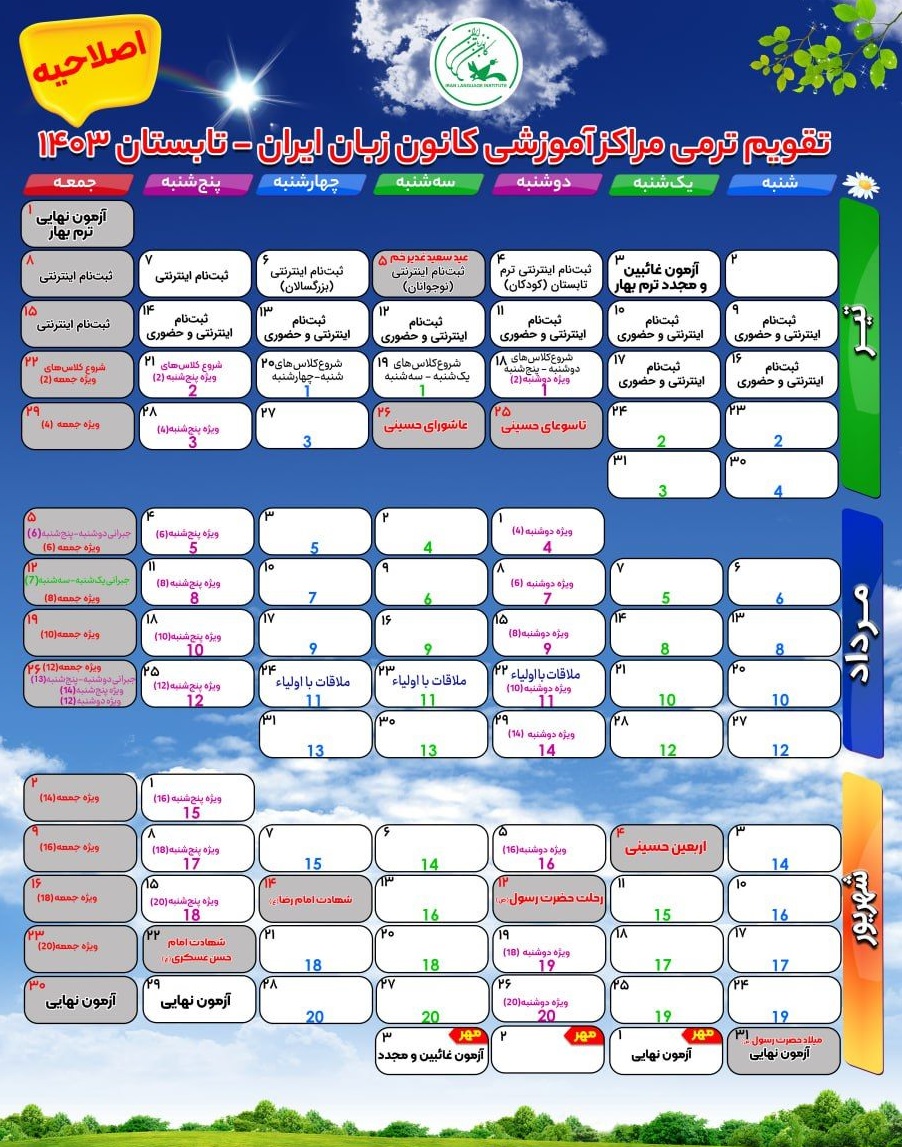
The Calendar of the ILI in the Summer Term of 1403