Advanced 1
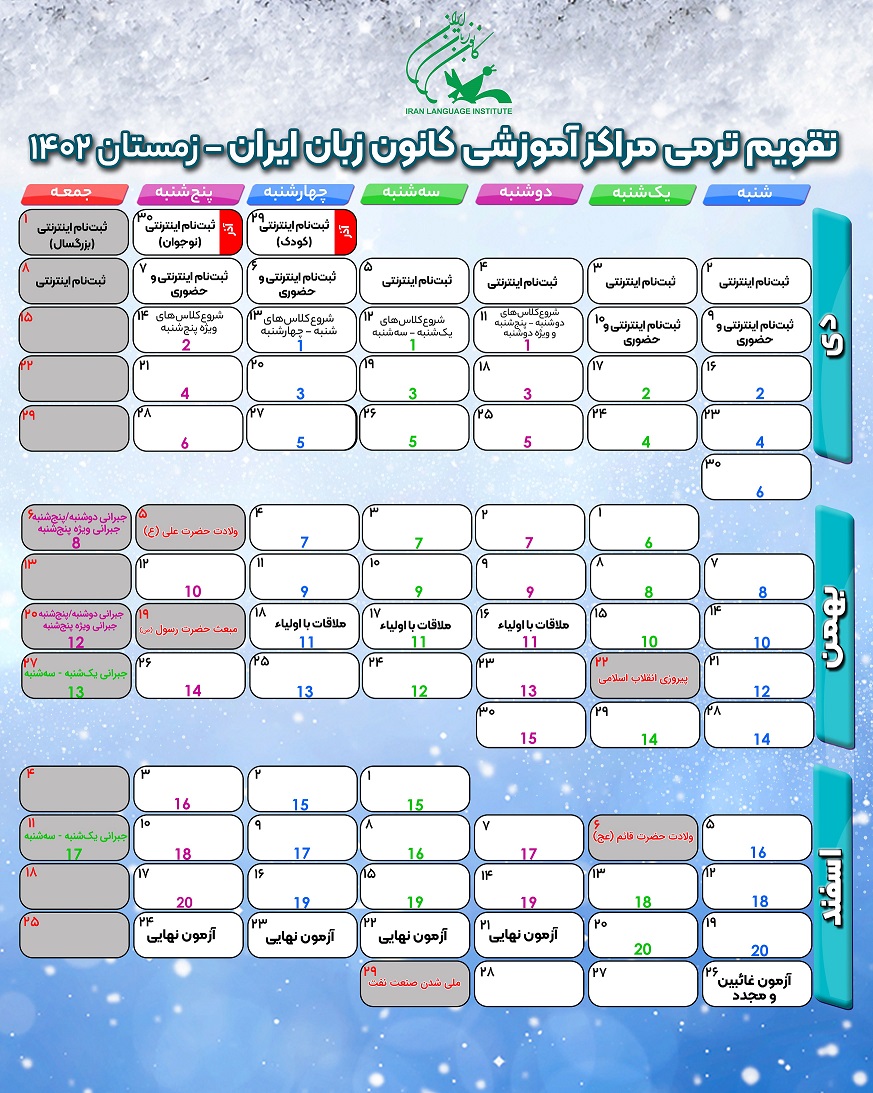
Sunday Tuesday 20:30-22:00

Your Last Visit: 08:15:46 AM Refresh the Page
The Messages by the Teacher:
Final Exam:
Monday (Esfand 21)9 a.m. - 11 p.m.
Website: exam.ili.ir
★Class Activity Grades
84.0 ایلیا عراقی85.0 آرش مقدم فر
25.0 امیرحسین اخلاقی راسته کناری
91.0 محمد مهدی مختاری
89.0 عرفان عجمی
96.0 مهدی درویشی
75.0 شهراد طاهریان
76.0 رادین سلامی
80.0 امیرعلی شیخ سفلی
88.0 محمد صادق سرباز
25.0 محمد پاریاد
75.0 امیرعلی حسین زاده
25.0 علیرضا تقوی
93.0 سینا شریفی اردانی
93.0 امیررضا وظیفه دوست
93.0 کیا مرادیان
36.0 عرفان سعیدی کیا
25.0 میلاد ترابی انارکی
81.0 محمد پارسا نظری نژاد گیاشی
25.0 محمدجواد استاجی
★The Details of the Scores
4 ➨ Good 👍👍3 ➨ OK 👍
2 ➨ Weak 👎
1 ➨ Not Ready 👎👎
Student's ID Number: 9510050112
Name: ایلیا عراقی
Listening: 3 4
Mean = 3.5
Speaking: 3 3 4 3
Mean = 3.25
Reading: 3 3
Mean = 3.0
Writing: 3
Mean = 3.0
Pronunciation: 3 3 3
Mean = 3.0
Grammar: 4 4
Mean = 4.0
Vocabulary: 3 3
Mean = 3.0
Orthography: 3 4
Mean = 3.5
Assignment: 4 4 4
Mean = 4.0
Rating Scale = 3.36
Total Score = 84.0
Student's ID Number: 9610080154
Name: آرش مقدم فر
Listening: 4 4
Mean = 4.0
Speaking: 3 3
Mean = 3.0
Reading: 3 3
Mean = 3.0
Writing: 3
Mean = 3.0
Pronunciation: 4 3 3 3 3
Mean = 3.2
Grammar: 3 4 4 3
Mean = 3.5
Vocabulary: 4 3 3 4 3
Mean = 3.4
Orthography: 3 4
Mean = 3.5
Assignment: 4 4
Mean = 4.0
Rating Scale = 3.41
Total Score = 85.0
Student's ID Number: 9314070012
Name: امیرحسین اخلاقی راسته کناری
Listening: 1
Mean = 1.0
Speaking: 1
Mean = 1.0
Reading: 1 1
Mean = 1.0
Writing: 1
Mean = 1.0
Pronunciation: 1
Mean = 1.0
Grammar: 1
Mean = 1.0
Vocabulary: 1
Mean = 1.0
Orthography: 1
Mean = 1.0
Assignment: 1
Mean = 1.0
Rating Scale = 1.0
Total Score = 25.0
Student's ID Number: 991129900
Name: محمد مهدی مختاری
Listening: 4 4
Mean = 4.0
Speaking: 3 3 3 4 4
Mean = 3.4
Reading: 3 3 4 4
Mean = 3.5
Writing: 4
Mean = 4.0
Pronunciation: 4 3 3 3 4
Mean = 3.4
Grammar: 3 4
Mean = 3.5
Vocabulary: 3 3 3 4 3
Mean = 3.2
Orthography: 4 4
Mean = 4.0
Assignment: 4 4 4 4 4
Mean = 4.0
Rating Scale = 3.64
Total Score = 91.0
Student's ID Number: 9514260002
Name: عرفان عجمی
Listening: 4 4
Mean = 4.0
Speaking: 3 3
Mean = 3.0
Reading: 3 3 3
Mean = 3.0
Writing: 3 4
Mean = 3.5
Pronunciation: 3 3 3
Mean = 3.0
Grammar: 4
Mean = 4.0
Vocabulary: 4 4
Mean = 4.0
Orthography: 4 4
Mean = 4.0
Assignment: 4
Mean = 4.0
Rating Scale = 3.58
Total Score = 89.0
Student's ID Number: 9710150135
Name: مهدی درویشی
Listening: 4 4
Mean = 4.0
Speaking: 4 3 4 4 4
Mean = 3.8
Reading: 4 4 4 4
Mean = 4.0
Writing: 4
Mean = 4.0
Pronunciation: 4 4 3 3 4
Mean = 3.6
Grammar: 3 3 3 3
Mean = 3.0
Vocabulary: 4 4 4 4 4
Mean = 4.0
Orthography: 4 4 4 4
Mean = 4.0
Assignment: 4 4 4 4 4
Mean = 4.0
Rating Scale = 3.83
Total Score = 96.0
Student's ID Number: 9810150656
Name: شهراد طاهریان
Listening: 3 3
Mean = 3.0
Speaking: 1 4
Mean = 2.5
Reading: 1 4
Mean = 2.5
Writing: 3
Mean = 3.0
Pronunciation: 3 3 4
Mean = 3.33
Grammar: 3
Mean = 3.0
Vocabulary: 4 3 3
Mean = 3.33
Orthography: 3
Mean = 3.0
Assignment: 4 3
Mean = 3.5
Rating Scale = 2.99
Total Score = 75.0
Student's ID Number: 9610150068
Name: رادین سلامی
Listening: 3 3
Mean = 3.0
Speaking: 3 3
Mean = 3.0
Reading: 3 4
Mean = 3.5
Writing: 3
Mean = 3.0
Pronunciation: 3 3 4
Mean = 3.33
Grammar: 3
Mean = 3.0
Vocabulary: 3 3
Mean = 3.0
Orthography: 3
Mean = 3.0
Assignment: 1 4
Mean = 2.5
Rating Scale = 3.05
Total Score = 76.0
Student's ID Number: 9610150029
Name: امیرعلی شیخ سفلی
Listening: 3
Mean = 3.0
Speaking: 3 3
Mean = 3.0
Reading: 4 4
Mean = 4.0
Writing: 3
Mean = 3.0
Pronunciation: 3 3 3
Mean = 3.0
Grammar: 3
Mean = 3.0
Vocabulary: 3 4 3
Mean = 3.33
Orthography: 3
Mean = 3.0
Assignment: 3 3
Mean = 3.0
Rating Scale = 3.18
Total Score = 80.0
Student's ID Number: 9610150537
Name: محمد صادق سرباز
Listening: 4
Mean = 4.0
Speaking: 3 3
Mean = 3.0
Reading: 4 3
Mean = 3.5
Writing: 3
Mean = 3.0
Pronunciation: 3 3 3
Mean = 3.0
Grammar: 4 4 4
Mean = 4.0
Vocabulary: 3 4 4
Mean = 3.67
Orthography: 3
Mean = 3.0
Assignment: 4 4 4
Mean = 4.0
Rating Scale = 3.5
Total Score = 88.0
Student's ID Number: 9310150006
Name: محمد پاریاد
Listening: 1
Mean = 1.0
Speaking: 1
Mean = 1.0
Reading: 1
Mean = 1.0
Writing: 1
Mean = 1.0
Pronunciation: 1
Mean = 1.0
Grammar: 1
Mean = 1.0
Vocabulary: 1
Mean = 1.0
Orthography: 1
Mean = 1.0
Assignment: 1
Mean = 1.0
Rating Scale = 1.0
Total Score = 25.0
Student's ID Number: 9513090170
Name: امیرعلی حسین زاده
Listening: 3
Mean = 3.0
Speaking: 3 3
Mean = 3.0
Reading: 3 3
Mean = 3.0
Writing: 3
Mean = 3.0
Pronunciation: 3
Mean = 3.0
Grammar: 4 3
Mean = 3.5
Vocabulary: 3
Mean = 3.0
Orthography: 3
Mean = 3.0
Assignment: 3 2
Mean = 2.5
Rating Scale = 2.99
Total Score = 75.0
Student's ID Number: 9510360132
Name: علیرضا تقوی
Listening: 1 1 1
Mean = 1.0
Speaking: 1
Mean = 1.0
Reading: 1
Mean = 1.0
Writing: 1
Mean = 1.0
Pronunciation: 1
Mean = 1.0
Grammar: 1
Mean = 1.0
Vocabulary: 1
Mean = 1.0
Orthography: 1
Mean = 1.0
Assignment: 1
Mean = 1.0
Rating Scale = 1.0
Total Score = 25.0
Student's ID Number: 9610360029
Name: سینا شریفی اردانی
Listening: 4 4
Mean = 4.0
Speaking: 3
Mean = 3.0
Reading: 4 4
Mean = 4.0
Writing: 3 4
Mean = 3.5
Pronunciation: 4 4
Mean = 4.0
Grammar: 3 4 4 4
Mean = 3.75
Vocabulary: 4 3
Mean = 3.5
Orthography: 3 4
Mean = 3.5
Assignment: 4 4
Mean = 4.0
Rating Scale = 3.7
Total Score = 93.0
Student's ID Number: 9819010046
Name: امیررضا وظیفه دوست
Listening: 3 4 4 4
Mean = 3.75
Speaking: 4 4
Mean = 4.0
Reading: 4 4 4 1
Mean = 3.25
Writing: 4
Mean = 4.0
Pronunciation: 3 4 4 3 4
Mean = 3.6
Grammar: 3 3 4
Mean = 3.33
Vocabulary: 3 4 4 4 4
Mean = 3.8
Orthography: 4
Mean = 4.0
Assignment: 4 4 4
Mean = 4.0
Rating Scale = 3.73
Total Score = 93.0
Student's ID Number: 9725020073
Name: کیا مرادیان
Listening: 4 4 4 4
Mean = 4.0
Speaking: 4 4 4 4
Mean = 4.0
Reading: 4 4 4 3 4
Mean = 3.8
Writing: 3 4
Mean = 3.5
Pronunciation: 4 4 4 4 4
Mean = 4.0
Grammar: 4 4 4 4 3
Mean = 3.8
Vocabulary: 3 3
Mean = 3.0
Orthography: 3 4
Mean = 3.5
Assignment: 4 4 3
Mean = 3.67
Rating Scale = 3.73
Total Score = 93.0
Student's ID Number: 9413040013
Name: عرفان سعیدی کیا
Listening: 1 1
Mean = 1.0
Speaking: 1
Mean = 1.0
Reading: 1
Mean = 1.0
Writing: 1
Mean = 1.0
Pronunciation: 3
Mean = 3.0
Grammar: 1
Mean = 1.0
Vocabulary: 3
Mean = 3.0
Orthography: 1
Mean = 1.0
Assignment: 1 1
Mean = 1.0
Rating Scale = 1.43
Total Score = 36.0
Student's ID Number: 1400409158092
Name: میلاد ترابی انارکی
Listening: 1
Mean = 1.0
Speaking: 1
Mean = 1.0
Reading: 1
Mean = 1.0
Writing: 1
Mean = 1.0
Pronunciation: 1
Mean = 1.0
Grammar: 1
Mean = 1.0
Vocabulary: 1
Mean = 1.0
Orthography: 1
Mean = 1.0
Assignment: 1
Mean = 1.0
Rating Scale = 1.0
Total Score = 25.0
Student's ID Number: 9714150011
Name: محمد پارسا نظری نژاد گیاشی
Listening: 4
Mean = 4.0
Speaking: 3
Mean = 3.0
Reading: 3 3
Mean = 3.0
Writing: 3
Mean = 3.0
Pronunciation: 3 3
Mean = 3.0
Grammar: 3 3
Mean = 3.0
Vocabulary: 3 3
Mean = 3.0
Orthography: 3
Mean = 3.0
Assignment: 4 4
Mean = 4.0
Rating Scale = 3.26
Total Score = 81.0
Student's ID Number: 9614230031
Name: محمدجواد استاجی
Listening: 1
Mean = 1.0
Speaking: 1
Mean = 1.0
Reading: 1
Mean = 1.0
Writing: 1
Mean = 1.0
Pronunciation: 1
Mean = 1.0
Grammar: 1
Mean = 1.0
Vocabulary: 1
Mean = 1.0
Orthography: 1
Mean = 1.0
Assignment: 1
Mean = 1.0
Rating Scale = 1.0
Total Score = 25.0
Session 20
Unit 4: Writing (PDF)Unit 5: Writing (PDF)
Unit 6: Writing (PDF)
PROGRESS CHECK Two
EXERCISE A1. c
2. e
3. b
4. j
5. a
6. i
7. d
8. f
9. g
10. h
1. high-tech
2. short-term
3. user-friendly
4. hand-held
5. built-in
6. long-lasting
7. touch-sensitive
8. call-in
9. labor-saving
10. battery-operated
EXERCISE B
1. a. benevolently b. benevolence c. benevolent
2. a. conceptualize b. conception/concept c. concept
3. a. suffocation b. suffocated c. suffocating
4. a. intrigued b. intriguing c. intrigue
5. a. subsides b. subsidiary c. subsidize
6. a. visually b. visualize c. visual
7. a. pessimism b. pessimists c. pessimistic
EXERCISE C
1. from
2. into
3. with
4. in
5. down
6. out
7. atop
8. for
9. within
10. on
EXERCISE D
1. racist
2. alcoholic
3. vandal
4. critic
5. feminist
6. hero
7. optimist
8. pessimist
9. cynic
10. idealist
EXERCISE E
1. heroism
2. criticism
3. pessimism
4. vandalism
5. optimism
6. idealism
7. feminism
8. racism
9. plagiarism
10. cynicism
EXERCISE F
1. stranger
2. current
3. altered
4. shade
5. historic
6. disused/outskirts
7. chest of drawers
8. surrounded
9. dated
10. evicted
EXERCISE G
1. long
2. colored
3. soft
4. intense
5. raw
6. extremely
7. thoroughly
8. dreary
9. growing
10. meaningless
EXERCISE H
1. ashamed of
2. hear about
3. waiting room
4. blow over
5. ill-fated
6. face danger
Homework:
Progress Check 2 (Pages 134-138)Session 19
WORKBOOK UNIT SIX
EXERCISE A1. exodus
2. pessimist
3. weeds
4. preface
5. inflation
6. precede
7. oasis
8. famine
EXERCISE B
1. cramped
2. envisage
3. tend
4. aspiration
5. quota
6. prospect
7. gauge
8. mainstream
EXERCISE C
1. persistent pain
2. vibrant city
3. urban development
4. premature birth
5. premeditated murder
6. stark reality
7. cramped building
8. delicate operation
EXERCISE D
1. presumption
2. presumably
3. illustrative
4. illustration
5. perpetually
6. perpetuate
7. fertilized
8. fertility
EXERCISE E
1. at
2. for
3. with
4. on
5. with
6. to
7. with
8. to
Unit 6: Language Focus 2 (PDF)
EXERCISE F
1. d
2. g
3. a
4. b
5. h
6. c
7. e
8. f
1. The couple living in the house next door are both university professors.
2. The pillars holding up the roof have been damaged.
3. The people driving past waved to us.
4. The man operating the equipment was dressed in protective clothing.
5. The girl waiting for the bus is Jack's daughter.
6. The teachers attending the meeting decided to go on strike.
7. The steps leading down to the river are dangerous.
8. The piece of land stretching away to the left all belongs to Mr. Thompson.
EXERCISE G
Line 3: ... was coming, so they had …
Line 6: ….to relax. Then the telephone rang.
Line 7: …. in the bathroom; she called … or ... in the bathroom. She called
Line 9: … on the door. It was… or … on the door; it was
Line 11: …. over my coffee; however, I had to … or ... over my coffee. However, I had to …
Unit 6: Mini-Listening
Jenny ⇨ landfills ⇨ do more recycling
Adam ⇨ the thinning of the ozone layer ⇨ drive less
Kate ⇨ water pollution ⇨ treat all waste products more carefully
TRANSCRIPT FOR MINI-LISTENING (TIME: 4': 25")
1) JennyJenny: You know, I've been reading a lot about the problem of landfills—and it really has me worried.
Man 1: Why?
Jenny: Well, it seems that the easiest way of disposing of trash is by burying it in landfills. The problem is that in many countries the landfills have already been filled up, and it's hard to find places to start new ones. No one wants a huge landfill anywhere near their neighborhood.
Man 1: So what's the solution?
Jenny: Well, there is no easy solution. But many cities are trying to do more recycling so that they can reduce the amount of stuff that goes into the landfills.
2) Adam
Woman: I can't believe it's become dangerous to get a suntan. What is this world coming to?
Adam: Well, the sun has never been good for you, but it's really dangerous now. You see, the ozonosphere, which helps protect us from the sun's ultraviolet rays, has been damaged by pollution in the air. When the ozone layer gets too thin, it can cause an increase in skin cancer and other problems.
Woman: But is there anything we can do to solve the problem?
Adam: Sure. One of the biggest threats to the ozone layer is cars—the exhaust gases from cars. The best way to save the ozone layer is to drive less. So in many places, people are being asked to carpool.
3) Kate
Kate: You know, you always hear about air pollution, but not many people are aware of the problem of water pollution.
Man 2: You mean in the oceans?
Kate: No. I mean polluted drinking water. It's a problem in almost every major city in the world. Almost all our rivers and lakes—where we get our drinking water from —are being polluted in some way by businesses, farms, homes, industries, and other sources. And even though the water most of us drink is treated, it's still not 100 percent pure.
Man 2: So what's the solution?
Kate: Well, it's a complicated problem to solve, but basically what's involved is treating all waste products more carefully so that dangerous chemicals and bacteria don't get into our water supply.
Unit 3: Writing (PDF)
Homework:
Workbook (Unit 6)Session 18
A & B => Arash MoghadamfarC & D => Mohammad Sadegh Sarbaz
E => Kia Moradian
F => Shahrad Taherian
G => Mohammad Mahdi Mokhtari
The Reading of Unit 6
The Passage in Simple English
APeople have believed this idea for a long time: there are too many people on Earth and they will make our cities too crowded and use up all the things we need from the planet. We are hurting the Earth: making water cover the land, chopping down trees, and killing the places where animals and plants live before we even know what they are. Our future will be bad, mean, and tight.
B
But maybe this is not true. Now, some people who study how many people there are on Earth have begun to doubt the idea that we will all die because of too many people. They agree that there will be more people, but they say that this will not be as fast or as long as people used to think. They even say they can imagine the day when there will be the most people on Earth and then it will start to go down.
C
Some people who study numbers say this: fewer people are having babies now. In the past, each woman had about six babies on average. Now, each woman has about three babies on average, and this number is going down. This means that by the year 2050, there will be nine billion people on Earth, which is half more than now. This is bad for the Earth, but not as bad as some people thought before. They thought there would be fifteen billion people by then. Also, the people who study numbers think that after 2050, there will be fewer people on Earth, not more. This makes us wonder two things. Why did people stop having so many babies? And what will happen when there are fewer people on Earth?
D
The first question has different answers in different places. For example, in Europe, people who are married will have one or two kids, but before they would have three or four kids. There are many reasons for this. Women can now work and do what they want, and they are not bad if they don’t get married and have kids when they are young. This means that there are fewer women who can have kids. Also, parents want good things for their kids, things that their parents or grandparents did not have, but these things need money, like going to college or traveling. These and other things make people have fewer kids in Europe. The average is 1.4 kids for each couple. But a country needs 2.1 kids for each couple to keep the same number of people. So you can see that in the future, there will be fewer people in Europe.
E
Other countries have different and more scary reasons for having fewer people. Russia’s people are going down by almost 750.000 every year. The reasons are drinking too much, bad health care, and dirty air and water that make men less able to have kids. In China, the government tells people how many kids they can have, and it thinks that its people will be most at 1.5 billion by 2019 then go down a lot. Some people who study this say that China could have twenty to thirty percent fewer people every time new kids are born. There is also the movement from the farms to the cities, which is happening all over the world. Soon half of the people in the world will live in cities. But in cities, kids need more money than in farms, and this makes people have fewer kids.
F
All this is hard to measure. In Europe, people who study population say that there will be a big drop in the people who will work and make money, while the people who are old and need help will go up a lot. So, a British leader said that women should have kids for their country. This makes sense. There will be no workers if people do not have kids. Right now, the middle age of people is twenty-six; in a hundred years, if things keep going like this, that will be twice as much. More and more old people will need help from fewer and fewer young people. In China, the problem is bigger. Most young Chinese people have no siblings and have to take care of two parents and four grandparents by themselves. Money and help for old people are not enough to deal with the problem.
G
Some people hope that we can have a good economy without more people, but most people who study money are not hopeful. On the other hand, it is obvious that having fewer people is good for the Earth in the long run. Until we stop making more of ourselves, we will keep destroying the last big natural places, like the Amazon. Just after the big cold time, there were only a few hundred thousand people on Earth. Since then, the number of people has become ten thousand times more. This is too fast, and we are not good at stopping it. This will make our future unsure.
Homework:
The Summary of each Paragraph in the Reading of Unit 6The Answers to the Questions on Pages 122-125
Session 17
ENHANCING YOUR VOCABULARY: Unit 6
1.1. h
2. e
3. a
4. f
5. j
6. g
7. b
8. i
9. c
10. d
2.
1. crops
2. retailers
3. blueprints
4. altered
5. ecological
6. organism
7. self-perpetuating
8. herbicide
9. toxins
10. weeds
Unit 6: Listening
LISTENING TASK 1
Advantages:Crops could be made resistant to plant-killing animals.
Crops could be made resistant to bacteria, viruses and insects.
More nutritious food could be developed.
Disadvatges:
There could be new toxins in food.
Diseases could spread across different species of plants.
Herbicide-resistant plants could grow out of control.
The ecological balance could be disturbed.
LISTENING TASK 2
1. against
2. against
3. in favor of
4. in favor of
5. in favor of
6. against
TRANSCRIPT (TIME: 6': 58")
Reporter: You're in the supermarket deciding what you want to buy. The tomatoes and corn look especially delicious. But wait! Do you stop and wonder if those vegetables have been genetically modified? Wouldn't you want to know before you bought them? Shouldn't they be labeled so that you have the right to choose? What are genetically modified foods? Genes are the blueprints for an organism. Genetic engineering is the process of artificially modifying these blueprints. Scientists can transfer the desirable genes of one organism to another—altering its genetic make- up. Scientists now are routinely using genes from bacteria, viruses, insects, fish, and animals to modify food crops. Supporters of genetically-modified foods want crops that are resistant to herbicides—plant-killing chemicals that farmers use to kill unwanted weeds and plants. Supporters also say that these new genetically-altered crops such as corn, potatoes, and soybeans are more resistant to certain bacteria, viruses, and insects. Others claim that in the future scientists will develop foods that are more nutritious and able to prevent disease. Opponents of genetically-modified foods are worried about the dangers. ... and they list many. New toxins in foods, the spread of disease across species, disturbances in the ecological balance, herbicide-resistant plants that may grow out of control. They claim that we don't know what the long-term effects of producing genetically-modified foods will be. And once changes are made in the genetic structure of organisms, they cannot be reversed. The problem will be self-perpetuating. At the very least, opponents of genetically-modified food want producers and retailers to clearly mark products that contain genetically-modified ingredients. Will all this technology result in better crops and healthier food? Or is there a risk to humans and the environment that should not be ignored?
Unit 1: Writing (PDF)
Unit 2: Writing (PDF)
There is no class next week on Sunday (Bahman 22).
But there is a class on Tuesday (Bahman 24) and a make-up class on Friday (Bahman 27).
Make-Up Class:
Friday Bahman 27
2:00 p.m. - 3:30 p.m.
Homework
The Answers to the Questions Following the Reading in Unit 4The Summary of each Paragraph in the Reading of Unit 4
Session 11
LISTENING
ENHANCING YOUR VOCABULARY
1.1. e
2. h
3. d
4. c
5. j
6. a
7. b
8. f
9. g
10. i
2.
1. survive
2. set out
3. leaped/leapt (Br.E.)
4. chattering
5. crash
6. civilization
7. keep up
8. berries
9. Beans
10. bleeding
LISTENING TASK 1
a. 8b. 4
c. 9
d. 7
e. 2
f. 6
g. 10
h. 3
i. 5
j. 1
LISTENING TASK 2
a. Fb. T
c. T
d. F
e. T
f. F
g. T
h. F
i. F
j. F
TRANSCRIPT (TIME: 10': 43")
Friend: Molly, it's so good to see you! What an adventure! How on earth did you survive? And what were you doing in South America anyway?Molly: Well, it was quite an experience! I was on my way to Belem to do some research for an article about the rain forest.
Friend: Uhuh.
Molly: Before I left, I called my friend Steve in Belem to let him know that I was flying in that evening. It was a small plane and the weather wasn't too good, so I was pretty scared, but I had to be in Belem that night. Everything was fine until the weather started to get worse. There was a lot of thunder and lightning, and just as we were flying over some mountains, the engines started to make some really strange noises. Then suddenly the engines stopped ... we started to fall.
Friend: Oh, no! What did you do?
Molly: Well, there was nothing I could do. I was sure I was going to die and there was nothing I could do about it. The plane just fell and fell and then there was a crash and everything went black. When I woke up, I was in a tree and there were pieces of the plane all around me. By then it was getting dark and it was pretty cold. My head hurt and my arm was bleeding and there was nothing but the sounds of the forest—I felt so alone.
Friend: So what did you do?
Molly: Well, first I climbed out of the tree. That was really painful because my arm hurt a lot. In fact, I found out afterwards that it was broken. When I got to the ground, I just lay down and slept.
Friend: How could you sleep out there in the forest? Weren't you frightened?
Molly: Yes, I was terrified, but I was totally exhausted. I didn't sleep very well because it was so cold and I was so frightened. It's freezing in the forest at night. Anyway, as soon as it was light, I started to think about what I was going to do. I was all alone in the middle of nowhere. I had no idea where I was or how to find my way back to civilization. I was also really hungry.
Friend: Hungry? At a time like that?
Molly: Yes, I hadn't eaten for hours and I knew I had to keep my strength up if I was going to survive.
Friend: So what happened then?
Molly: Well, first, I found some berries. I didn't know what they were, or if they were good to eat or poisonous. But I was so hungry that I had to eat something. Then while I was eating the berries, I remembered that when you are lost in the forest, you are supposed to look for a river. Firstly, because you need water to drink, and also because rivers lead out of the forest. So I set out to try to find a river.
Friend: But you could have been miles away from a river!
Molly: I was. I walked all day until I couldn't walk anymore, and I found nothing. I just got more and more lost. And that evening, I realized that I might never find my way out. I might die in the forest and no one would ever find me.
Friend: How awful! You must have felt really alone.
Molly: I did, but just as I was starting to feel really depressed, I saw a monkey sitting in a tree. He had come over to see what I was doing and he started chattering at me and leaping from branch to branch. That made me laugh. It was the first time I had laughed since the crash, and I decided at that moment that somehow I was going to survive.
1.3 FOLLOW-UP
1. whale2. frog
3. dog
4. goose
Some Interesting Facts about Animals
★Cheetahs are the fastest land animals, capable of reaching speeds up to 60-70 miles per hour in short bursts covering distances up to 1,500 feet.★Elephants are known for their exceptional memory and intelligence. They have the largest brain of any land animal.
★Octopuses have three hearts. Two pump blood to the gills, while the third pumps it to the rest of the body.
★Koalas sleep up to 20 hours a day. They have a slow metabolic rate due to their high-fiber, low-nutrient diet.
★The tongue of a blue whale is so large that 50 people could stand on it.
★Ants don’t have lungs. Oxygen enters through tiny holes all over the body and carbon dioxide leaves through the same holes.
★Some birds, like pigeons, are known to be monogamous. They mate for life and also share the responsibilities of caring for their offspring.
★The flea can jump up to 200 times its body length. This is equivalent to a human jumping the length of a football field.
★Bats are the only mammals that are capable of sustained flight.
★A snail can sleep for three years at a stretch.
Homework
Enhancing Your Vocabulary => Page 73Session 10
Progress Check One
EXERCISE B1.
a. substantiate
b. substantially
c. substantial
2.
a. prominence
b. prominent
c. prominently
3.
a. segregation
b. segregated
c. segregationist
4.
a. influences
b. influenced
c. influential
5.
a. prevailed
b. prevailing
c. prevalence
6.
a. reputable
b. reputedly
c. reputation
7.
a. alienating
b. alienation
c. alien
EXERCISE C
1. into
2. in
3. of
4. at
5. with
6. from-into
7. across
8. for
9. in
10. by
EXERCISE D
1. over
2. re
3. dis
4. micro
5. under
6. well
EXERCISE E
1. loyal (≠disloyal)
2. inedible (≠edible)
3. dissimilar (adj)
4. uncomfortable (adj)
5. ex-wife (ex- = previous)
6. reasonable (≠unreasonable)
EXERCISE F
1. dark-skinned
2. shoulder-length / medium-length
3. tight-fitting / close-fitting
4. sun-tanned
5. high-heeled
6. short-sleeved
7. clean-shaven
8. well-dressed / smartly-dressed
9. well-built
10. good-tempered / even-tempered
EXERCISE G
1. police
2. well
3. self
4. semi
5. public
6. youth
7. coffee
8. short
9. bar
10. court
Homework:
Progress Check 1 (Pages 66-71)Session 9
WORKBOOK Unit Three
EXERCISE A1. b
2. a
3. d
4. c
5. c
6. a
7. b
8. d
EXERCISE B
1. maturity
2. initial
3. undermine
4. menace
5. inevitable
6. vindictive
7. tangible
8. Consumption
EXERCISE C
1. viable option
2. tangible improvement
3. unethical behavior
4. grave concern
5. competitive price
6. tremendous success
7. cute baby
8. initial response
EXERCISE D
1. demonstrable
2. demonstration
3. persuasion
4. persuasively
5. sequentially
6. sequential
7. defiance
8. defiantly
EXERCISE E
1. to
2. in
3. of
4. to
5. into
6. to
7. of
8. to
Unit 3: Language Focus 2 (PDF)
EXERCISE F
1. Although I washed my hands, they still looked dirty.
2. Diana didn't know how to swim. However, she jumped into the swimming pool.
3. I wouldn't trust Alan with my money, although he seems to be trustworthy.
4. Thomas was thirsty. However, he refused the glass of water I brought him.
5. I'm going horseback riding with Judy this afternoon, although I'm afraid of horses.
6. Anna's father gave her some good advice. However, she did not follow it.
7. Although you have made it clear that you don't want any help, I must offer to help you.
8. Alan seems capable as a financial advisor. However, I wouldn't trust him with my money.
Unit 3: Language Focus 3
EXERCISE G
1. left
2. was
3. would
4. OK
5. OK
6. were
7. could
8. OK
9. OK
10. aided
11. died
12. decided
13. lived
14. OK
15. OK
Unit 3: Mini Listening
Product / Is it selling well? / Why or why not?
subzero sleeping bag / yes / It is warm, takes up less room, and is lightweight
compact, portable electronic dictionary / no / Kids have computers and most word-processing programs have spell check
remote-control device to start the car / yes(during the winter holidays) /People hate waiting in winter to start the car; it sends out a signal that heats or warms up the car
TRANSCRIPT FOR MINI-LISTENING (TIME: 4': 05")
Salesperson 1: OK, our new subzero sleeping bag here has a patented design, and it has revolutionary filling. We've had it tested by hikers and campers in subzero temperatures. And they're not only happy with the warmth, but they're also very pleased with how light it is. Now, our bags also take up less room than the bulkier, heavier sleeping bags you're used to, so campers don't have to sacrifice any of their equipment. We found that people who are new to hiking didn't like the term "subzero" because the idea of being outdoors when it's that cold is not very appealing. So, now we just emphasize how warm and lightweight it is, and it's selling better than any other sleeping bag!
Salesperson 2: You know, I first thought that this compact, portable electronic dictionary was going to sell really well—especially with the back-to-school market. You know, all school kids need to check a dictionary, right? Well, it just doesn't seem to be taking off, I'm finding out that more and more kids these days have computers. And you know that computers have software with dictionaries, and most word-processing programs have spell check. Then I thought, "OK, there are still people who like to write the old-fashioned way, with pen and paper." Well, a number of those people have told me that they still like the old-fashioned dictionaries, too.
Salesperson 3: We sell this really neat remote-control device that sends out a signal to start your car. It even lets you heat it up before you have to go out. That's a really great feature in the winter. So often, you know, people complain about how long it takes to warm up the car. People hate being cold ... and they hate having to wait even more! This gizmo sells really well during the winter holidays.
Homework:
Workbook (Unit 3)Session 8
The Reading of Unit 3
A => Radin Salami
B => Mohammad Sadegh Sarbaz
C => Kia Moradian
D => Amirreza Vazifehdoust
E => Sina Sharifi
F => Mohammad Parsa Nazarinezhad
G => Amirali Sheikhsofla
H => Mahdi Darvishi
Homework:
The Answers to the Questions on Pages 56-58 => To be uploaded on eili.irThe Summary of each Paragraph in the Reading of Unit 3 => To be presented in the class
Session 7
Unit 3: ENHANCING YOUR VOCABULARY
1.1. g
2. c
3. j
4. d
5. f
6. i
7. c
8. b
9. h
10. a
2.
1. effective
2. scaring off
3. ancestors
4. detergent
5. campaign
6. laundry
7. commercials
8. slogans
LISTENING TASK ONE
1. "Come alive". "Pepsi brings your ancestors back from the dead.”2. ………. on the left, a box of laundry soap in the middle, and a pile of clean clothes on the right. They should have changed the order of the pictures.
3. until ... when.
4. ENCO. "Engine stop.”
LISTENING TASK 2
Conversation 1:1. a
2. b
Conversation 2:
1. a
2. b
Conversation 3:
1. a
2. b
Conversation 4:
1. b
2. a
TRANSCRIPT (TIME: 11': 22")
Number 1: ChinaBoy: This is funny.
Girl: What's that?
Boy: I'm reading this article about bad advertisements. You know, advertising mistakes.
Girl: Yeah!
Boy: Of course, you know, Pepsi Cola, the soft drink company. Remember their old "Come alive" commercials?
Girl: Sure, come alive, with all those young people drinking Pepsi and suddenly being full of energy and life.
Boy: Well, when Pepsi was sold in China, "Come alive" was translated as "Pepsi brings your ancestors back from the dead.
Girl: Well, I guess Pepsi brings your ancestors back from the dead is one way to come alive. But I don't think that's what they had in mind.
Boy: But I don’t think that’s what they had in mind.
Number 2: The Middle East
Boy: Here's one I wouldn't have thought of. You know those before-and-after commercials for laundry soap?
Girl: The ones with a pile of dirty clothes on one side and then the same clothes after they've been washed? Sure.
Boy: There was an American company that had one of those ads. It was really successful in North America. In the ad, there was a pile of dirty clothes on the left, a box of laundry soap in the middle, and a pile of clean clothes on the right. So the message was that a box of this detergent would make really dirty clothes clean.
Girl: Yeah!
Boy: So, what do you think happened when they used the ad in the Middle East?
Girl: I don't know.
Boy: Think about it. In the Middle East, languages are written from right to left. People look at things from right to left.
Girl: So, it looked like that this soap made the clothes dirty?
Boy: Our soap will make your clothes dirty—not a very smart ad campaign!
Girl: They should have changed the order of the pictures. They should have put the picture of the clean clothes on the left and the dirty clothes on the right.
Boy: Really!
Number 3: Mexico
Boy: Oh, here's another one. Some shirt maker put an ad in a Mexican magazine.
Girl: And?
Boy: Well, the ad was supposed to say "When I wore this shirt, I felt good," but they made a translation mistake.
Girl: What did they say?
Boy: Instead of" When I wore this shirt," the ad said, "Until I wore this shirt, I felt good.'
Girl: Until I wore this shirt, I felt good? Gee, changing one little word gave it the opposite meaning.
Number 4: Japan
Boy: The article says sometimes it's not just the advertising slogan that gets companies into trouble. Sometimes the company name can scare off business.
Girl: What do you mean?
Boy: Well, there was a large oil company in the United States called ENCO: E-N-C-O.
Girl: Yeah, I remember them.
Boy: They opened some gas station in Japan and they advertised using their American name. Unfortunately, they didn't know what the word means in Japanese.
Girl: What does it mean?
Boy: Enco is a short way of saying "Engine stop" in Japanese.
Girl: Great! Would you buy gasoline from a company that said your car engine would stop?
Boy: No and neither did the Japanese.
Homework:
Enhancing Your Vocabulary (Page 47) => to be uploaded on eili.irSession 6
WORKBOOK Unit Two
EXERCISE A1. T
2. F
3. T
4. F
5. F
6. F
7. T
8. T
EXERCISE B
1. virtually
2. segregate
3. subtle
4. compulsory
5. advocated
6. equitable
7. deliberately
8. substantial
EXERCISE C
1. physical
2. fulfill
3. trip
4. raised
5. wide
6. needs
7. significant
8. outperformed
EXERCISE D
Nouns
withdrawal
fulfillment
motivation
submission
Verbs
detain
implement
assess
enhance
1. implement
2. submission
3. withdrawal
4. detain
5. enhance
6. motivation
7. fulfillment
8. assess
EXERCISE E
1. at
2. of
3. on
4. to
5. on
6. in
7. by
8. on
Unit 2: Language Focus 2 (PDF)
EXERCISE F
1. c
2. e
3. b
4. g
5. a
6. h
7. f
8. d
1. Although little is known about the artist's early life, a lot has been found out about his later.
2. Many people believe that capital punishment is a deterrent to serious crime, though it actually makes little difference to the crime rate.
3. We usually consider it healthy to eat lots of fruit, whereas too much can produce an excess of acid in the stomach.
4. I enjoy having people stay, though I always appreciate the peace when they have gone.
5. Although the main medium of communication on the Internet is English, many web sites now operate in other languages.
6. Iain Banks's early novels were considered quite strange, while his later books are more mainstream and accessible.
7. I tend to drink more white coffee, whereas my husband prefers black.
8. Global warming is often considered the main factor in current climate fluctuations, while climate change has long been a feature of the Earth's development.
Unit 2: Language Focus 3 (PDF)
EXERCISE G
1. ………………. were bare; they made…………….
2. ……………… victims, so we sent ……
3. ……………… her health; therefore, she…………
4. While ……………… on schoolwork, the average ………
5. ……………… high-calorie candy bars. We also …………
6. …………….. modern art; however, during his lifetime
7. ……………….. South America, yet it has one of
8. …………….. with the occult; it is merely
Homework:
Workbook (Unit 2) => to be uploaded on eili.irSession 5
🎧The Audio File of the Reading in Unit 2
A => Arash Moghadamfar
B => Mahdi Darvishi
C => Mohammad Mahdi Mokhtari
D => Amir Reza Vazifehdoust
E => Kia Moradian
F => Erfan Ajami
G => Ilia Eraghi
H => Amir Ali Sheikhsofla
I => Amir Ali Hosseinzadeh
❌According to Cecilia Reynolds, says in Canada, girls' performance better than boys'.
✔️According to Cecilia Reynolds, in Canada, girls' performance is better than boys'.
✔️Cecilia Reynolds says in Canada, girls' performance is better than boys'.
❌The gap has been disappeared.
✔️The gap has disappeared.
❌This number each year decrease.
✔️This number decreases each year.
❌We haven't paid as much as attention boys need.
✔️We haven't paid as much attention as boys need.
✔️We haven't paid enough attention to what boys need.
READING: Unit 2

WARMING UP
2
a. enthusiasm
b. broadband
c. fee/tuition
d. bully
e. truancy
f. waiting list

DISCUSSING THE PASSAGE

EXERCISE A
A. a
B. b
C. a
D. b
E. b
F. a
G. a
H. b
I. a

EXERCISE B
1. c
2. c
3. c
4. b
5. b

EXERCISE C
1.
1. b
2. h
3. j
4. a
5. c
6. i
7. d
8. f
9. e
10. g
2.
1. c
2. e
3. j
4. b
5. h
6. i
7. a
8. f
9. d
10. g
Homework:
The Answers to the Questions on Pages 38-40 => to be uploaded on eili.irThe Summary of each Paragraph in the Reading => to be presented in the class
Session 4
Unit 2: ENHANCING YOUR VOCABULARY
1.
1. F
2. C
3. G
4. H
5. B
6. D
7. E
8. A
9. I
10. M
11. J
12. K
13. L
14. O
15. N

2.
1. passed
2. give
3. recognizes
4. attempt
5. complete
6. send
7. leave
8. keep
9. partial
10. assigned
11. state
12. nursery
13. subjects
14. failed
15. taught
Unit 2: Listening (Audio File)
LISTENING TASK 1
Amy Patrick Karen1 ✔️ ❌ ✔️
2 ✔️ ❌ ❌
3 ❌ ✔️ ❌
4 ❌ ❌ ✔️
5 ❌ ❌ ✔️
6 ✔️ ✔️ ❌
LISTENING TASK 2
1. parochial2. clothes
3. discipline system
4. dressed
5. warmly
6. competitive
7. study
8. nervous
9. period
10. challenging
TRANSCRIPT (TIME: 17': 28")
First Amy- So, Amy, tell us about your first day of high school.
Amy: Oh, my gosh! I remember it so vividly because I had gone to a very small parochial school all my life. And it was I that really pushed my mom to allow me to go to public school because I really wanted to experience the difference between public school and private school. And all of my friends were going to public school and they were all talking about the different freedoms that they had there which I had never really experienced. So, here I was all of a sudden very afraid even though she and I had spent pretty much all summer discussing how I was going to do in public school and what might be expected of me and how I might have to be more of self-starter. Because I don't know if you've ever been to private school. But in private school everything is pretty much set up for you and you just have to follow along and the schools are fairly small. But then when I went to high school and I actually saw it, the school was tremendous; I mean it was huge and my first thought was, "Oh, my gosh! How am I ever going to be able to find my way around this really really huge building?" And then the bell rang. It seemed like there were more kids there than I'd ever seen together at one time in my entire life.
- So, did they have you wear any kind of uniform at the high school?
Amy: That was the other thing. When my mom and I had gone shopping, I really didn't have any idea of what kind of clothes I should wear because first of all I had been really really sheltered and I didn't really have too much of an idea about fashion because I had never had to before. We wore uniforms in private school. So all of a sudden here I was trying to look like one of the in-crowd and I don't think I did too well.
- So, were the teachers very different at the high school? Or the size of the classes?
Amy: The classes were really really large. In private school we maybe had 8 to 10 kids in a classroom. And then all of a sudden here I was in a big classroom with maybe 30 students. And one teacher who pretty much just wrote things on the board and it was up to you whether you wanted to follow it or not and the discipline system was so completely different. Kids were sort of talking and whispering and the school I came from that was so not allowed.
- So, how did you feel about that? Did you like high school better than junior high school? Amy: In some ways I liked it more, but in other ways I really missed the discipline and the structure.
Now Patrick
- So, Patrick, tell us about your first day of high school.
Patrick: Aha, my first day! Oh, boy! Well, we just moved into a new neighborhood and I remember I was pretty excited. I remember dressing up and wearing a tie and everything and when I got there it was kind of informal. The kids were kind of like you know; you wear what you want to wear. But I was, I guess, I was kind of scared. You know and excited at the same time. I remember I was late. Because we just moved into the neighborhood, and I remember my dad took me. And then there was just warm really warm teacher, Mrs. Seratta. I remember her name. And I mean what a greeting! I mean. She was in the middle of something. You know, orientation and everything. But I remember we got a great greeting. I looked around. Everybody looked really friendly. I mean those were all new, new folks for me. You know, new students and everything. I guess I felt pretty much at home. I mean that was a very good experience in high school as opposed to junior high. But it was very competitive high school I remember and I said, "Hey, I'm gonna have to really hit the books." You know which was kind of fun. Because a lot of the kids from my class who were in my class lived in my neighborhood and you know, and they had like little study groups. So it was a pretty good experience, I mean, high school for me was a fun time and a very nurturing time for me.
- That's great.
Finally Karen
- So, Karen. Tell us about your first day of high school.
Karen: I remember I didn't want to go. I think I was really nervous about going to a very big new school and they had just built a new high school. So, more than half of my friends were going to another high school. So I was getting ready to enter a high school where I didn't know anybody or so I thought. And I, yeah, I was really nervous about that. Um, when I got there, it wasn't that bad. You know, I went to my first period class. And it turned out that one of my best friends ended up being in my class. So, that was pretty cool. Um, but overall I really didn't like high school that much. I mean I don't know it was... um... I just kind of couldn't wait to get out of there. Actually I didn't find it that challenging. You know, I remember going and sitting in the classes and being kind of bored. And, yeah, seriously, and I always got good grades, but I never had to study much. And it just was, it was too easy I think. Yeah, I don't think that I felt challenged enough to tell you the truth.
- So, did you enjoy your junior high school more than your high school?
Karen: I think I did. Yeah, there was more of a sense of freedom, strangely enough. And I think when I entered high school for whatever reasons I was just a little more nervous about being someplace different where I didn't know anyone and so I think that's probably what was hard about it. But, yeah, middle school, definitely was a more fun time for me, yeah.
Homework:
Enhancing Your Vocabulary (Pages 30 & 31) => To be uploaded on eili.irSession 3
WORKBOOK Unit One
EXERCISE A1. F
2. I
3. A
4. C
5. E
6. B
7. G
8. D
EXERCISE B
1. Overrun
2. repressed
3. acclaimed
4. spawned
5. alienation
6. inclination
7. unprecedented
8. prevalence
EXERCISE C
1. deeply
2. rash
3. big
4. let
5. drumming
6. ultimate
7. increasing
8. made
EXERCISE D
1. prioritize
2. priority
3. resistance
4. irresistible
5. Deviant
6. deviate
7. entitled
8. entitlement
EXERCISE E
1. to/of
2. on/upon
3. at
4. of
5. to
6. of
7. with
8. on
Unit 1, Language Focus 2: Coordination
Unit 1: Language Focus 2 (PDF)EXERCISE F
1. Both Kate and Mary practice yoga after work.
2. Neither Kate nor Mary likes judo.
3. Neither Kate nor Mary goes home to change between work and her yoga class.
4. Kate eats either cereal or fruit before her yoga class.
5. Mary thinks that practicing yoga helps her not only reduce stress but also keep in shape.
6. After yoga class, both Kate and Mary usually want to eat.
7. Kate encourages not only her husband but also her son to practice yoga.
8. The instructor wants both Kate and Mary to try the advanced yoga class.
Unit 1, Language Focus 3: Fragments
Unit 1: Language Focus 3 (PDF)EXERCISE G
1. Fishing is one of the oldest sports in the world and can be one of the most relaxing. A person with a simple wooden pole and line can have as much fun as a sportsman with expensive equipment. For busy executives, overworked teachers, and even presidents of nations, fishing can be a good way to escape from the stress of demanding jobs.
2. The first electric car was built in 1887. It was sold commercially six years later. At the turn of the century, people had great faith in new technology. In fact, three hundred electric taxicabs were operating in New York City by 1900. However, electric cars soon lost their popularity. The new gasoline engine became more widely used. With our concern over pollution, perhaps electric cars will become desirable once again.
The Mini Listening of Unit 1
TRANSCRIPT FOR MINI-LISTENING (TIME: 4': 32")
Lisa: Uh, well, I'm a freelance writer, and that means that I work at home. And a lot of people think my job is easier because I don't have to go to the office every day. And I don't have to deal with office politics. But, you know, the truth is, my job is very hard. I have to be very organized and very disciplined. And pretty self-motivated. And when I have a problem, there is no one around to help me—I have to solve it myself. And sometimes I worry about money. So when I get stressed, I take a hot bath to relax, and then I curl up in front of the TV with a cup of hot tea. And that usually does the trick at the end of a long and very hard day.Sean: Traffic stresses me out. I do a lot of driving to school and to my part-time job. Drivers can be so rude, especially during rush hour. I try to ignore them by listening to my favorite music in the car. Then, when I get home, I try to do something fun to relax. I watch a funny movie or go to a friend's house—something like that. Anything to take my mind off school and work.
Victor: I work in the hospital emergency room. You can imagine how stressful that is! Everyone is in a hurry and under tremendous pressure. The doctors are demanding, and there's always too much to do. I cope with all this stress by going to the gym at least four times a week. My friend got me started weight lifting, and now I'm addicted. When I feel especially frustrated, it feels good to go to the gym and throw those weights around. The other thing I do is get out of the city. Every month or so, I go for a drive in the country. The fresh air and the quiet do wonders for me.
The Answers to the Mini Listening Exercise
Lisajob is hard; has to be organized, disciplined, and self-motivated; sometimes worries about money
takes a hot bath, curls up in front of the TV with a cup of hot tea
Sean
traffic, rude drivers
listens to music in the car, watches a funny movie, goes to a friend's house
Victor
everyone is in a hurry and under tremendous pressure; demanding doctors
goes to the gym at least four times a week, goes weightlifting, goes for a drive in the country
Homework
Workbook => Unit 1Session 2
Unit 1: Reading
Unit 1: Reading (PDF)
A => Arash Moghadmfar
B => Mahdi Darvishi
C => Amir Reza Vazifehdoust
D => Erfan Ajami
E => Amir Ali Sheikhsofla
F & G => Milad Torabi
H => Sina Sharifi
❌It is become extremely.
✔️It has become extreme.
✔️It is becoming extreme.
Point
"Become" is a linking verb. Linking verbs are modified by adjectives, not adverbs.
Exercises
WARMING UP
2.
1. prioritize
2. down-to-earth
3. idiot-proof
4. clutter
5. delegate
6. peak

DISCUSSING THE PASSAGE
EXERCISE A
A: a
B: b
C: b
D: a
E: a
F: b
G: a
H: b

EXERCISE B
1. d
2. c
3. b
4. a
5. a

EXERCISE C1
1. f
2. j
3. a
4. i
5. c
6. e
7. h
8. g
9. b
10. d

EXERCISE C2
1. j
2. g
3. c
4. a
5. i
6. h
7. d
8. f
9. b
10. e
Homework
The Answers to the Questions Following the Reading of Unit 1 (Pages 16-18) => To be uploaded on the website eili.irThe Summary of each Paragraph of the Reading in Unit 1 => To be presented in the class
Session 1
Enhancing Your Vocabulary
1.
1. d
2. f
3. a
4. i
5. g
6. c
7. j
8. e
9. h
10. b

2.
1. auditioned
2. panicked
3. back and forth
4. rehearsals/rehearsing
5. stressful
6. commute
7. incredibly
8. stressed out
9. to relieve
10. handled
Unit 1: Listening
TRANSCRIPT (TIME: 9’: 31”)
First JaredJared: You see, I come from a small town. When I started going to college in a large city, I felt really confused and lonely. I didn't know anybody. I didn't know what to do with myself on the weekends. It was hard to make friends. But then, someone told me about the drama club. I went over there and auditioned and I got in. Now I have a lot of new friends there. And I'm busy every weekend with rehearsals and performances. It's great!
Now Maria
Maria: Well, I'm in medical school now. But when I was preparing for the entrance exam, I was so stressed out. There was so much material that I had to memorize. I was so scared I wouldn't be able to pass that test that I started to panic. Well, I learned to organize my time much better and I started a study group with some of my friends. Well, of course, in the end I passed the exam, and so did they!
Now John
John: I work at an Internet company. Um, we're a new company, so, you know, it always seems like there's more work than we can possibly handle. Sometimes we work really long hours, easily until after 9 or 10 at night. Well, I really needed to do something fun after work to, uh, to relieve stress. So I started taking ballroom dancing lessons. It's incredibly fun, and I've gotten pretty good at it. I even enter ballroom dancing competitions!
Now Emi
Emi: Well, I used to work as an administrative assistant in a large company. The pay was pretty good. But I didn't really like the job that much. It just got to be so ... boring, and I always felt like I would be happier doing something else. Then one day I just quit my job. Yes, just like that! Now I work in a flower shop in my neighborhood. I don't make that much money but I am much happier.
Finally Doug
Doug: My job really isn't that stressful. Actually, I really like my job. I like my job a lot, but the commute back and forth was absolutely terrible. I used to drive my car to work every day— during rush hour, stop-and-go traffic, all the way to and from—and when I look back on it, uh, I really don't know how I was able to deal with that traffic without going crazy. But then, I realized that I didn't have to drive. I could take the train, and now on the train I can relax, I can have a cup of coffee, I read the paper, and on the way back home, I can even sleep.
Task 1:
Jared:- felt confused and lonely
- didn't know anybody
- didn't know what to do with himself on the weekends
Solution:
- auditioned for a drama club and got in
- busy every weekend with rehearsals and performances.
Maria:
-preparing for the entrance exam and feeling stressed out
- had to memorize so much material
- feeling scared that she wouldn't be able to pass
Solution:
- learned to organize her time much better
- organized a study group with some of her friends
John:
- busy and working long hours because of a new company
Solution:
- took ballroom dancing lessons and entered competitions
Emi:
- didn't like her job because it was so boring
Solution:
- quit her job, now working in a flower shop in her neighborhood
Doug:
- driving and commuting back and forth in heavy traffic
Solution:
- taking the train now and reading, drinking coffee, and even sleeping on the way back home
LISTENING TASK 2
1. a
2. b
3. a
4. a
5. b
6. b
7. a
8. b
9. a
10. b
Student's Book & Workbook (PDF) Download the Zipped File
Introduction
Mohammad RajabpurLanguage Teacher, Computer Programmer, & Website Designer
Languages: English (C2), French (B2), German (A1), Persian (Mother Tongue)
Programming Languages: Python, C++, C#, Basic, Html, CSS, Javascript, PHP
Qualifications
Master's Degree in Computational Linguistics from Sharif University of TechnologyMaster's Degree in English from Shahid Beheshti University
Contact Information
📞 09900909701✉ mr@anglophone.ir
The Web Page of Your Class: www.anglophone.ir/classes/0241ad1/
The Page of Ad1: www.anglophone.ir/ad1/
How to Send Your Homework
Upload your homework on the website eili.ir through your student's panelIf the website of the ILI doesn't work for any reason, you can send me your homework via email or Telegram (Please include your name and level in every message)
The Calendar of the ILI in the Winter Term of 1402
Comments:
Please enter your name and comment below:
Here are the published messages:
2024-01-01 02:18:14
Admin's Reply: Hello Ali